BOMB DAMAGE TO BRIGHTON SECTION OF THE SOUTHERN RAILWAY
Clapham Junction Tuesday 7th January 1941
Involving the 12.51. p.m Victoria to Coulsdon North
Fratton Depot Friday 10th January 1941
Portsmouth Harbour Friday 10th January 1941
Streatham Hill Saturday Friday 31st January 1941
Newhaven Branch Meeting
Sunday February 16th 1941
With regards to the minute re the equipment of engines Bro. Cable said that when approached, Bro. Sherwin got on to Brighton by telephone and the reply from Brighton was "we have none too." "there is a war on.”
Correspondence
Bro. Clarke pointed out that Mac's, Gum-boots & etc were supplied for the shed staff soon after the outbreak of the war and that shed staff grade and not footplate men should be recruited for fire-watching as any "as ordered" man, might also be classed as a Fire-watcher when not otherwise engaged.
BOMB DAMAGE TO BRIGHTON SECTION OF THE SOUTHERN RAILWAY
London Bridge Monday 17th February 1941
Peckham Rye Saturday15th March 1941
New Cross Gate Wednesday 19th March 1941
LOCOMOTIVE JOURNAL
MARCH 1941
EDITOR'S NOTES
WAGES APPLICATION
Many will have gathered from Press statements that up to date no settlement has been reached in connection with the application for an increase of 10s. per week which was made by the three railway Unions to the Railway Executive Committee.
The situation is by no means satisfactory, although it must not be thought that negotiations have yet been concluded.
I. fear that there are far too many people in high places who do not appreciate the real value of railway work to the nation in these times of stress. All the criticism and comments of those who represent Stockholders' Associations and Employees' Organisations, individuals who fly to the Times and Daily Telegraph with letters urging that a uniform wage policy should be adopted, are creating a situation that may be difficult, if not dangerous, for all concerned. I note that in the Daily Telegraph on February 13th, Sir Ronald Matthews on behalf of the Associated Chambers of Commerce goes to very great lengths to justify this attitude. One may be pardoned for suggesting that although Sir Ronald points out that workpeople not organised are prejudiced by the fact that better rates at secured in organised industries, that he does not do this with any feeling of sympathy with those who are unorganised, but rather because he objects to what organised workpeople endeavour to do to better their position. The principle is one which undoubtedly will be depressed in various ways, and there are some of us who are going to strongly object to any attempt that might be made to follow the line indicated by Sir Ronald Matthews.
Most of us are anxious to assist in the war effort, but we certainly are not desirous of seeing of seeing victory attend the efforts of the nation merely to protect the position of those associated with either Stockholders' Associations or the various Chambers of Commerce in the country. It is something much greater than that for which we must aim and the "After War Britain" must be a place in which all workpeople receive not only a fair return for their labour but a good return for such.
LOCOMOTIVE JOURNAL
MARCH 1941
ST. LEONARD’S BRANCH
Our January meeting was very well attended, and it was also interesting. We had some of the oldest members of the Society there; also some of the youngest. They all came to say farewell to one of our eldest members who has now retired and is now on the superannuation benefit. Our retired member (Bro. J. Philpot) has been a member since 1912 and has assisted the branch through serious times. Bro. R. Niner attended the meeting, although himself on the sick list, to make a presentation to Bro. Philpot in the form of a pair of easy chairs, presented by his workmates at the depot. Bro. Niner spoke of the good work done by our brother in years past for the benefit of Trade Unionism. Bro. A. Levett (Ore Branch) also spoke of our colleague’s good work. The members present wished Bro. Philpot health and good luck in these difficult times, and also wished Bro. Niner a quick recovery from his illness.
Now a word or two for our members at home. It was very encouraging to see so many at our last meeting: now, if you all come, it will be more so. You will also know how the Society is watching your interests in these difficult times and the conditions we are working under. So it is hoped that all members will do their utmost to make the meetings in 1941 still better.
D. Sargent
Branch Secretary
BOMB DAMAGE TO BRIGHTON SECTION OF THE SOUTHERN RAILWAY
Fratton Tuesday 8th April 1941
Bognor Regis Friday 11th April 1941
Beckenham Junction Wednesday16th April 1941
Eardley Siding (Streatham Common) Thursday 17th April 1941
Fratton Depot Thursday 17th April 1941
Streatham Hill Sunday 20th April 1941
Lancing Works Friday 25th April 1941
Portsmouth & Southsea Sunday 27th April 1941
Fratton Depot Sunday 27th April 1941
Fratton Depot Saturday 3rd May 1941
Portsmouth & Southsea Sunday 4th May1941
EASTBOURNE LOCO SHED
BOMB DAMAGE TO BRIGHTON SECTION OF THE SOUTHERN RAILWAY
London Bridge Sunday 11th May 1941
Fratton Depot Thursday 12th June 1941
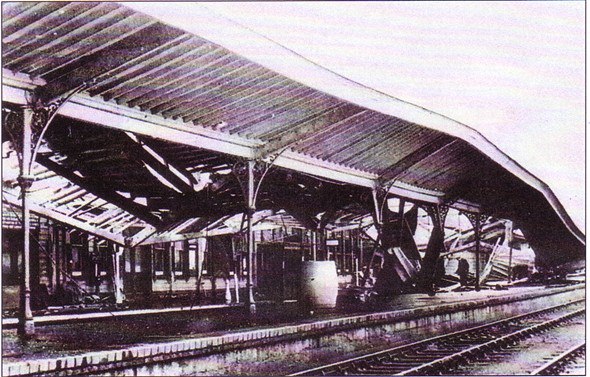
PHOTOGRAPHER UNKNOWN
Bomb damage at Newhaven Marine Station
LOCOMOTIVE JOURNAL
AUGUST 1941
FROM THE GENERAL SECRETARY'S PEN
WAGE INCREASE
Several questions have been asked by members respecting the payment of the 4s. advance, as applicable from January 6th last.
The queries submitted are as to the position of those men who retired from the service between January 6th and May 17th. In reply to these queries I have to point out that payment amounts due will be made to all men coming within this category.
The second query relates to the position, of the dependents of those who may have died during that period. To those inquiries, I would reply that, for any period of time worked between these dates concerned, the appropriate back payment will be made to the dependents.
The third point affects those who have left the service during this time. In these cases, the men concerned should submit an individual application to their former company, and their position will then be considered.
CANTEENS
This is a subject which is being discussed in many quarters and under varying circumstances. I would point out that an official application has been made by the Executive Committee to the railway companies for the institution of canteens, and I am hoping that this subject will be discussed at an early date.
The canteens which are visualised, are those at which rationed foods and hot meals can be obtained in the generally accepted quantities and consistent with the practice which applies in the works' canteens of war establishments.
CLOTHING RATIONING ORDER
Questions are being asked as to whether this Order will have any direct effect on uniform clothing by the surrender of coupons becoming necessary.
I am hoping that this will not be necessary, and have indicated this in no uncertain manner to all concerned.
It is early yet, however, to intimate what the position in regard to the surrender of coupons will be, and members will be advised immediately of any decision reached thereon.
LOCOMOTIVE JOURNAL
AUGUST 1942
THE EDITOR'S NOTES
The Government recently issued a White Paper on Price Stabilisation and Industrial Policy, which is of extreme importance in the world of trade union affairs. The contents of this document appear to strike at the very root of trade union rights, traditions and obligations.
Within the Order the following references appear:-
"Our shippping difficulties and the diversion of man power, machinery and factory space to the production of war materials have already greatly reduced the supply of goods for civilian consumption."
"This curtailment is inevitable, whatever money wages, salaries or profits are paid out. Increases in wages or other incomes would not make more goods available. Such increases would not raise the general standard of living; they would merely tend to send up prices and to denude the shops, making it difficult to secure a fair distribution of limited supply of goods."
"It is regarded as the duty of both sides in industry to consider together all possible means of preventing the rise of costs of production and so to obviate rise of prices which is the initial step in the inflationary process. The use of people is not less necessary than the application of managerial training and experience, and the maintenance of wages and employers' remuneration at a reasonable level should be achieved as far as possible by improvement in the efficiency of production by the joint efforts of employers and workpeople."
The intention appears to be that because supplies are curtailed that wage increases should not be sought, although the hidden suggestion is undoubtedly that of introducing a piece-work process, where an industry may be suited for it, or the working of longer hours per shift or week in order to increase production and perhaps earnings.
This is premise which is somewhat now. No increase in rate because there is a shortage or supplies! To accept that is to suppose that all rates of pay in industry are now satisfactory. Is that the fact? Of course not.
Changing conditions and circumstances will make demand for improvements imperative.
What does the trade union movement say to all this?
The General Council of the T.U.C. has refused to be a party to any statement of this des-cription or to anything that attempts to interfere with the ordinary rights of trade unions to negotiate on behalf of their members on the question of wages or conditions of service. It sets out its position in the following terms:-
"In the opinion of the General Council the statements in the White Paper on wage increases will induce employers to refuse increases and to remit claims to arbitration, and arbitration - particularly the National Arbitration Tribunal and the Industrial Court - will be bound to take note of such a pronouncement."
"Moreover, in arbitration proceedings attention will be drawn to the statement in the White Paper that maintenance of wages employers' remuneration at reasonable level should be achieved as far as possible by improvement in the efficiency of production by the joint efforts of employers and workpeople, and applicants will be required to show that output has actually increased or that a commensurately greater output would result from an increase in wages."
We heartily endorse the above sentiments and desire to make it clear that so far as locomotive men are concerned, we shall not hesitate to take any steps that may appear to us to be war-ranted to secure improvements in wage rates at any time. We shall hope that any such application will be considered upon its merits and would intimate that failure to do so is bound to create difficulties in the railway industry that would be harmful to the national effort.
This is neither a warning nor a promise of trouble, but a mere statement of fact.
LOCOMOTIVE JOURNAL
SEPTEMBER 1941
FROM THE GENERAL SECRETARY’S PEN
SICKNESS CERTIFICATES
Will members kindly note the necessity of obtaining the sickness certificate from the doctor within a period of three days of their having to declare on the funds of the Society. It is also necessary, in accordance with Rule that this shall be forwarded to our Kendal Office at once, Rule 29, Clause 3, stated "that the member shall, on the day that he obtains it, forward such certificate to the branch secretary, giving his full postal address."
On numerous occasions recently, particularly where new members are concerned, much delay has been occasioned and payment withheld because Rule has not been complied with. I am anxious to avoid such delay and to make payments promptly. Kindly, therefore, co-operate with me by supplying the medical certificates in the manner requested.
FIRE-WATCHING
Several enquiries are being made by member referring to the Fire-watching Order No. 69. It
may not be generally known that the Minster of Transport, who is the appropriate authority
scheduled by the Order, has now this Order compulsory so far as railways are concerned.
This means that fire-watching will take place at all points on the railways systems where it is considered to be necessary.A rota of duties will, therefore, be drawn up after consultation
with the representatives of the staff and exhibited for all concerned.
Our Local Departmental Committee Representatives should follow the advice set out in
circular letters issued from Head Office under dates of February, 7, March, 6, and May, 20.
It is essential that the discussion with the representatives of the staff should take place prior to Fire-watching duties being rostered.
In the meantime, we are seeking a meeting with the Minister of Transport in order to submit a number of points upon which clarity is needed and where amendment appears to be
necessary.
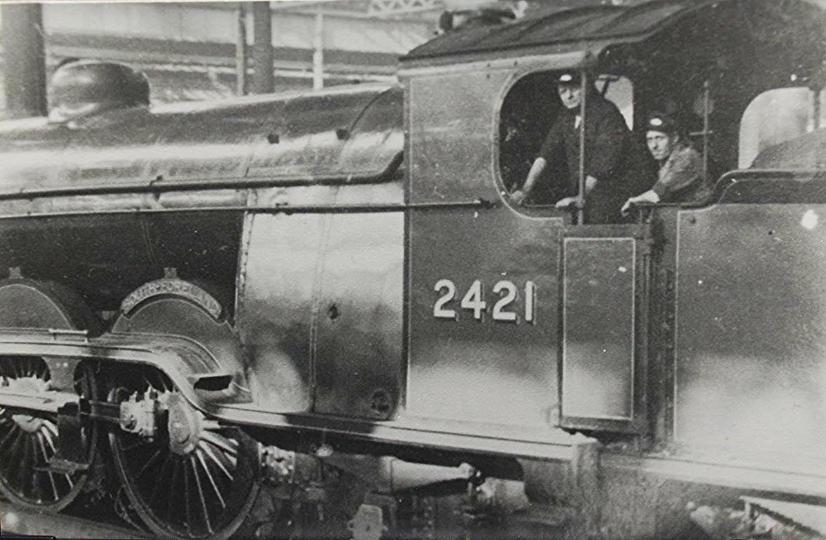
JOHN LIPSCOMBE COLLECTION
Newhaven Driver Fred Packham & Fireman Bill Lipscombe
Brighton Atlantic Class H2, No. 2421 “South Foreland”
In May 1941 Enginemen were awarded an extra 4s per Week taking the War Advance to 11s per week. Serious exception was taken by the Enginemen when an official Order on 'Fire-watching', which seemed to take no cognisance of our the Enginemen's very awkward of duty or the irregular nature of the turns they worked, to say nothing of the very long hours they were called upon to perform without any warning. When called upon to work these long hours without any provision being made to supply them with any food.
When the threat of invasion had receded, the Southern Railway became the marshalling area for troops preparing to invade Normandy in Operation ‘Overlord’, and once again the railways played its part by providing a link in the logistics chain. This came at a cost, as the Southern Railway’s location in and around London and the Channel ports meant that it was subjected to heavy bombing, whilst permanent way, locomotive, carriage and wagon maintenance was deferred until peacetime.
Brighton did in fact have women engine cleaners, they were not in the line of promotion and
their forewoman was a Mrs Roskelly who had a son who was a cleaner with me but he was
one of the dozens who left the railway A.S.A.P. after the war.
WOMEN ENGINE CLEANERS
CURTSEY OF TED JANES
The women engine cleaners were kept well
away from the rest of us rabble and sad to
admit they were a lot more enthusiastic
swabbing Gas Oil on engines than we were.
Inncidentally Fred Wheeler who was a
fireman at Brighton at the time, married one of the cleaner girls, he lived near me in
Hollingdean but later moved to Seaford as a
Motorman.
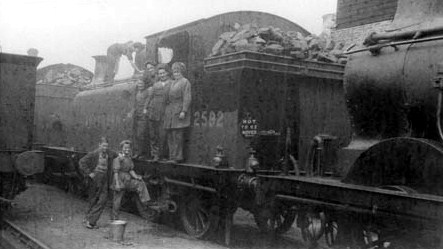
RALPH STENT COLLECTION
BRIGHTON MUSEM
There was also a tidy sized gang of women carriage cleaners at the station whose leader was
Mrs Watson ( Brighton Driver Ernie (Soapy) Watson's mum ).
Women played a very important role in the war. There was a Signal woman at Southwick, and the giant crane in Lower Yard was operated by Ernie Brown's sister, there were also a lot of female guards.
LOCOMOTIVE JOURNAL
SEPTEMBER 1941
PAGE 365
BATTERSEA BRANCH
Since our Branch Reporter is now at Chichester, I take it upon myself to give a report, and take this opportunity to thank all these members who have paid up their arrears last quarter, and also those members who are now regularly attending the branch room. I can also report good progress, 31 new and re-joined members, and success in the L.D.C. Election, Bro. A. Murray and myself securing the two places left vacant by the transfer of Bros. R. Taylor and Mepham; and we shall do our best to justify the confidence placed in us.
There are a good many outstanding complaints to remedy, and by the time this report is in print, we shall have had a meeting, and will be able to judge how far we have been successful with rearrangement and link working, shelter heating, the question of engine tools, guide lamps for shed roads before the long dark nights return, with possible air raids, and the provision of hand lamps. if we can get the Enginemen’s lobby roof repaired, it won’t be before time. The co-operation of the men is needed to make some of these things a success, if the company will do their part. To the younger element, I would remind them they have a contract with the company to be at work on time, every time you “do it in” you let one of your mates in for the turn, and he may be wanting to get done to time. So play the game, chaps, don’t expect all things to be done for you, if you are not prepared to do your share.
J. Polling
Branch Secretary
Brian Cook Collection