LOCOMOTIVE JOURNAL
JANUARY 1954
THE EDITOR'S NOTES
THE SETTLEMENT - AND AFTER
In last month's issue we printed the opening statement made on behalf of the Society in support of its wages claim before the Railway Staff National Tribunal. As all who persued those observations will readily acknowledge, the prime consideration advanced by us on that occasion was that the high degree of skill, the heavy responsibilities and the domestic and social disabilities attaching to the work of locomotivemen merited a much greater degree of recognition in terms of rates of pay.
This being so, the Tribunal Decision, when it appears in the terms which are so well known to all at this date, was all the more grievously disappointing. having regard to the flat rate nature and the niggardly amount of the increase awarded, the Decision amounted in effect to a gross insult to our fraternity.
STRIKE NOTICE
The E.C. were, therefore, called together for a special meeting on December 9th, when following full and serious consideration they unanimously decided to reject the Decision of the Tribunal. In order to further their declaration they decided also to give notice of withdrawal of labour. They, moreover, agreed to seek to have adopted at a joint meeting of the three Railway Trade Unions a mutually agreeable date for strike action. We deem it inappropriate in these notes, particularly at this time, to go into detail with respect to all that took place at the joint meeting of the Unions which was held on December 10th, other than to say that if our policy had been adopted the mechanics to give effect to our decision would have been vastly different, and the Government and all concerned would have been made aware of the situation immediately following the said meeting.
However, to ob unanimity it was agreed to press for a meeting with the Transport Com-mission, and on the same day (December 10th) they were informed of our rejection in Decision No.15, and notified of the Society's intention to withdraw the labour of its members as from midnight, December 20th. similar notification was given by the representatives of the N.U.R.; and the T.S.S.A. also intimated their total rejection of the Decision.
In view of subsequent developments, it must now be parent to all concerned that much mis-understanding and misrepresentation would have been avoided if the lead given by A.S.L.E.&F. in respect to the method to be adopted in tendering strike notice had been accepted.
NEGOTIATIONS AND SETTLEMENT
The next day (the 11th) a document was produced by the Commission which the Society's representatives were not immediately willing to accept; but in the subsequent discussions with the B.T.C., the following day, amendments to the document were effected, and definite assurances were given with respect to the points which we felt in duty bound to raise. Moreover, it was clearly indicated that in any subsequent negotiations the whole of the wages and salaries structure would be examined.
In reviewing this new development the Executive Committee readily acknowledged that the offer made was keeping with the policy of this Society as declared from time to time by the governing body, and strongly emphasised by the Society's advocate at the Railway Staff National Tribunal. In short, at long last the management had been prevailed upon to acknowledge in principle the justice of the claim that had been made for a proper recognition of responsibility within the wages structure. Accordingly, the E.C. decided to accept the document as a basis for further negotiations, provided arrangements could be agreed for an early meeting to be convened.
It was subsequently brought to our notice that the N.U.R. felt unwilling to accept the offer, and recognising that this eventuality prevented a settlement, we took appropriate measure to protect our position with respect to the notice to withdraw labour on December 20th, since under no circumstances could we accept R.S.N.T. Decision No.15.
On Monday, December 14th, the Minister of Labour summoned us to a meeting, and throughout we stressed the importance which we attached to the early commencement of discussions with respect to the whole of the wages and salaries structure, and we gave our reasons for so doing. Moreover, we made it clear to the Minister that our notice to the B.T.C. to call upon our members to take strike action on December 20th had not been withdrawn (a feature which was notified to our branches concerned), We further indicated that it was our aim and purpose to assist to the full in order to effect an amicable and satisfactory settlement to the dispute.
In the subsequent stages formulas were introduced, and at one period a suggestion was made whereby an examination of the rates of the lower paid workers would be considered and adjustment made in the case of other grades pending a final settlement. Consistent with our policy, we made it abundantly clear that in no circumstance could we accept any arrange-ments which did not provide for any interim wage advance to apply on a percentage basis. In keeping, however, with our clear understanding of the undertaking given by the B.T.C. on the Saturday previous, whereby an examination of the whole of the wages and salaries structure would take place, we clearly indicated that we were agreeable to any such advance applying to the whole of the people covered by the negotiating machinery, but we again emphasis that it must be on a percentage basis.
On Wednesday, December 16th, the parties were brought together, and the B.T.C. produced a further document which in certain parts was distasteful o us, firstly because it would, if approved, commit us to the acceptance of Decision No.15, and also because of a reference to the evolving of the ways and means of increasing the efficiency of the railway organisation, which we indicated we could not accept as a condition pertaining to a wages settlement. After obtaining satisfaction n these two important points together with other issues we deemed it necessary to raise we notified our acceptance of the settlement, and accordingly the Executive Committee rescinded their decision to take strike action on December 20th. The full terms of settlement are given in this issue of the Journal and will well repay careful study. As to their practical effect we cannot do better than quote the concise summing up contained in the E.C. circular announcing the result: "Because of the nature of the settlement now arrived at there will be three distinct phases"
firstly, the implementation by the B.T.C. of R.S.N.T. Decision No.15;
secondly, the interim award, which will be on a percentage basis, absorbing the 4s. award, ad will be effective from a date within two months of the operative date of the R.S.N.T. Decision No.15; and,
finally, the results of the examination of the wages structure and its consequent effect upon differentials. "
In addition to maintaining their rejection of Decision no.15, the society's representatives these heavy negotiations took their stand immovably upon three cardinal points of distinctively "Associated" policy:
(1) that any interim increase must be on a percentage basis, and must not be confined to the lower paid grades;
(2) that NO CONDITIONS must attach to any settlement arrived at; and
(3) that the vexed question of disturbance of relativity called for urgent and serious consideration with the object of the necessary improvements being effect.
Notwithstanding formidable difficulties which had to be surmounted in the course of negotiation, the settlement arrived at embodied, as will be seen, the full realisation of principles (1) and (2) above, and at long last it provided recognition of, and an avenue of progress towards, the third of these fundamental requirements.
1954 THE TESTING TIME
Thus, as the direct result of our Society's strength and advocacy, December, 1953, has seen developments of great importance in respect to the principles inherent in Society policy; and as a further result 1954 will prove a year of the highest significance in the struggle for fuller recognition of the craft values of our fraternity. Before this issue of the Journal reaches its readers the first discussions on new standard pay levels will have taken. The months ahead will make renewed heavy demands upon the Society's negotiators. They will also call, and no less insistently, for the maximum upbuilding of our forces and the wiping out of non unionism at all points where it is to found.
WE COUNT WITH CONFIDENCE UPON THE ACTIVE CO-OPERATION OF EVERY "ASSOCIATED" MEMBER TO THIS GREAT END
THE TERMS OF SETTLEMENT
PAGE 6
In our Editorial Notes this month we deal with the rejection by the Society of Railway Staff National Tribunal No.15, the notification of strike action to operate as from December 20th, and settlement following subsequent days of negotiation which have been described at length in Head Office circulars to branches. For the information of readers we print below the full terms of the settlement arrived at:-
1, The British Transport Commission have confirmed their acceptance of the award of the Railway Staff National Tribunal for an increase in rates of pay of salaried and conciliation staff. They are ready to implement it. In the light of the following, this position is accepted by the Trade Unions.
2, The British Transport Commission are prepared to examine with the Trade Unions their whole wage and salary structure. The British Transport Commission contemplate that this examination would be completely exhaustive, without conditions of any kind. It purposes would be to correct anomalies and give added incentives including differentials in desirable cases; and to investigate all standard rates of pay.
3, At the same time the British Transport Commission and the Unions agree to confer in order to evolve ways of increasing the efficiency of the railway organisation, not only by such adjustment of wages and salaries as may results form the above examination, but by all other appropriate means.
4, Recognising that the comprehensive review of the whole wage and salary structure will necessarily take some considerable time; and that the nature of the claim made by the Unions before the Railway Staff National Tribunal precluded that Tribunal from addressing itself to the question of the levels of the standard rates of pay; and after consultation with Her Majesty's Government, the British Transport Commission have given an assurance that, irrespective of other results emerging from the examination, within two months from operative date of the award there will be a further improvement on a percentage basis of the standard rates in operation immediately prior to the application of the award.
With referring to paragraph 1 of the above Terms of Settlement, we give below particulars of the arrangements which the Commission have arising therefrom, and which have been noted the Society:
LOCOMOTIVE JOURNAL
JANUARY 1954
LEATHERHEAD BRANCH
At our monthly October meeting we had a very enjoyable and interesting meeting, also good attendance. Our Sectional Council member, Bro. M.J. Renshaw, attended and gave us all an up-to-date report of Sectional Council’s activities. After his report several questions were asked and very suitably replied to. Being his first visit to our branch Bro. Renshaw’s attendance was very welcome and all look forward to similar visits in the future.
A vote of thanks was proposed to Monty for his able report. Our welcome was also extended to Wimbledon Branch who kindly attended this meeting. It also gives me great pleasure to state the progress o our branch in the course of the five years it has been opened and we are proud of the position we are in today. We all trust that our Society will obtain a pension scheme that is suitable and acceptable to all our members,
E.J. Beecher
Branch Secretary
LOCOMOTIVE JOURNAL
FEBRUARY 1954
THE EDITOR'S NOTES
TASKS OF THE HOUR
In our last month's editorial notes we described the crucial negotiations following the appearance of R.S.N.T. Decision No.15, its rejection by the Society's Executive Committee, and our giving notice of strike action to the Transport Commission. The notes concluded with reference to 1954 as a testing time for our fraternity.
This is a theme to which we recur without apology, in view of all that is involved. The Society is now engaged in negotiations for a fuller practical recognition of its members' craft value in terms of Clause 2 of the settlement published in our January issue.
A CO-OPERATIVE EFFORT
In itself, of course, that task is a job for our negotiations, as we indicated last month. They, needless to say, will spare no effort in connection therewith. But there are far wider implications, with duties which devolve alike upon us all. It was never more essential than at the present time, when such vital craft issues are under special consideration, that every practicable step should be taken without delay to enrol EVERY LOCOMOTIVEMAN within the A.S.L.E.&F., the only representative body, we say quite frankly, which is able and, moreover, the only body which is willing, to recognise and advance the special claims of Footplate Staff and Motormen.
Craft consciousness and membership of the "Associated" go hand in hand. In this connection we are indeed proud in the knowledge that our Executive Committee, in entering upon negations do so with an overwhelming "Associated" majority of the men in the line of promotion behind the, Nonetheless, so far as concerns the small section outside, there are certain observations which it is important should be made.
The non-unionist remains as ever a drag on the wheels and a menace which cannot be ignored. But the present especially is a time when he may be brought to see the light, both from the standpoint of his own interest as a footplateman, and in the interest of his fellows. It is a time when every addition to our Society's membership serves to re-emphasise our aspirations, and our firm refusal to sacrifice grade identity upon the altar of the lowest common denominator. It signifies anew to all concerned that locomotivemen decline to renounce their craft outlook or to tolerate the "fodder basis."
These are simple truths which it is necessary for us all to hammer home whenever the occasion arises. We are abundantly confident that each and every member will be fulfilling his duty in this respect during the months ahead.
THE LOCOMOTIVE JOURNAL
Side by side with activity on the foregoing lines, we also venture to express the hope that every endeavour will be made to promote sales of THE LOCOMOTIVE JOURNAL at all depots. Whilst, of course, readership of the Journal is no substitute for attendance at branch meetings, it is an invaluable supplement o the information obtained at such meetings. As a medium of propaganda our official organ is unavailable. It stands for the propagates craft pride and craft solidarity, by helping to keep the individual loco man in touch with wider aspect alike of his calling, of railway development, and last but not least, of the Society's activity on his behalf at national, district and local levels.
The most effective method of publicising our Journal is through the efforts of individuals in the depots. May we, therefore, enlist the aid of our readers everywhere in bringing its circulation up to a new high level in 1954, thereby extending and strengthening its influence in support of the Society's aims.
SECTIONAL COUNCILS ELECTION 1954
Finally, a word about the forthcoming Sectional Council elections on British Railways. On another candidates in this year's ballots in the respective Regions, and we have the utmost pleasure in commending them to the electors.
Thes elections furnish a first class opportunity for loco men, not only to renew their loyalty to Society policy at the vitally important Sectional council level, but also to show their wholehearted endorsement of the Society's current efforts in national negotiations, on their exclusive behalf.
SEE TO IT THEREFORE THAT THE "ASSOCIATED" CANDIDATES ARE RETURNED EVERYWHERE WITH BIGGEST-EVER MAJORITIES!
ERRATUM
In the last paragraph on page 6 of our January issue, it is indicated that the retrospective payments under R.S.N.T. Decision No.15 would be received on the pay day in the week ending January 9th. The date so given is a misprint for which we apologise; it should read January 16th.
LOCOMOTIVE JOURNAL
FEBRUARY 1954
BRIGHTON BRANCH No.2
We have had the pleasure of recent visits by Bros. P.G. Hockling and E. Cordell. It was
evident by the attention given and the able way which questions were answered, coupled with the helpful advice rendered by both these E.C. members, that those listening left the meeting fully satisfied that the past two hours had not been wasted.
Bro. Newbegin also attended at a meeting of L.D.C. representatives re duty bookings that are considered unsatisfactory, in consequence of which joint enquiry has been asked for.
The Retirement and Social Fund Committee once again arranged on November 21st a very
enjoyable evening at the Labour Club, when presentations were made to retiring Bros. J.
Pearce, C. Parker and T. Parsons. Gifts were handed to these Brothers by Bro. W. Boulton (Selhurst), and his words to each other were suitably replied to by the members concerned. Bro. Rickhard should also have received his retirement gift but illness of his wife prevent his being present. Excellent entertainment was provided by “The Revelaires" Concert Party, for which our grateful thanks are due.
May I remind members of this society that those in and around the Brighton are may join this fund on application to Branch Secretary, Bro. C. Stoner.
F. .W. MUSK
BRANCH CHAIRMAN
LOCOMOTIVE JOURNAL
FEBRUARY 1954
DISTRICT COUNCIL No.4
At the council meeting on November 30th, Bro. A.W. Lennard occupied the chair, with E.C. Member Hocking and Organiser Cleaver in attendance.
Bro, Hocking gave a lengthy description of the E.C.'s work during the past three months, dealing with the wage discussions at length. congratulations to the General Secretary on his statement, also his brilliant reply to the submission made on behalf of the B.T.C. The pension question has gone back to stagnation again as nothing further has taken place during the past three months. This is certainly the age of progress (backwards?). The interim report on the Physical and Eyesight Test was given in detail. Although this is only the proposal stage, the members on the Council were shocked, and it was proposed that the suggested New Standard Eyesight Tests, interim report, should be circulated to the branches at the earliest possible moment so that the rank and file can hear and discuss these serious proposals.
The E.C. propose that all agreements on Rest Day working be terminated, that the enhanced payment for rest day working be deleted from agreement. That Rest Days are the inviolable right of the men. Many questions followed on Pensions, wage discussions, etc. The transfer of men from dual panel to motorman came in for very serious criticism; some of the recent transfers were open to suspicion, and members said so very forcibly.
The Organiser gave his most able report of recent meetings dealing with the membership question, urging the prompt sending in of the quarter's dues, as delay means members may be out of benefit through no fault of their own. He dealt with disciplinary and other cases. It was of interest to all to hear, regarding the inquiry into the Bethnal Green mishap; the driver in the case being exonerated, it being found that he had his signals and the road, but for some reason unknown the points moved after the engine had passed over them. The driver was still alive (it makes one think, doesn't it!). Speed cases were also dealt with.
The meeting closed following a good day's work, with our Pedlar working hard for the Orphanage during the luncheon interval.
F. MILLER
Railway accidents on British Railways
Southern Region
Central Division
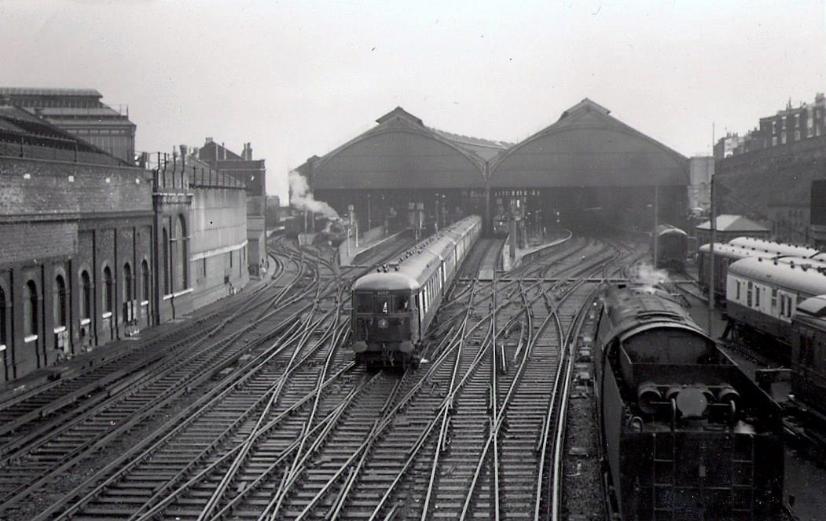
Windmill Bridge Junction 13th February 1954
Involving Portsmouth Motorman L.F. Chandler
SEE SUB PAGE
FOREST ROW
5th MARCH 1954
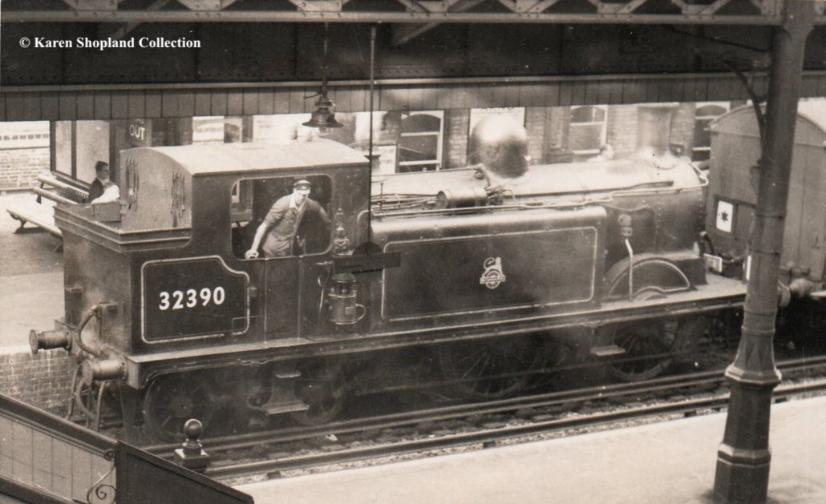
Driver T.W.W. Charlie Russell and his Fireman Ron Harper
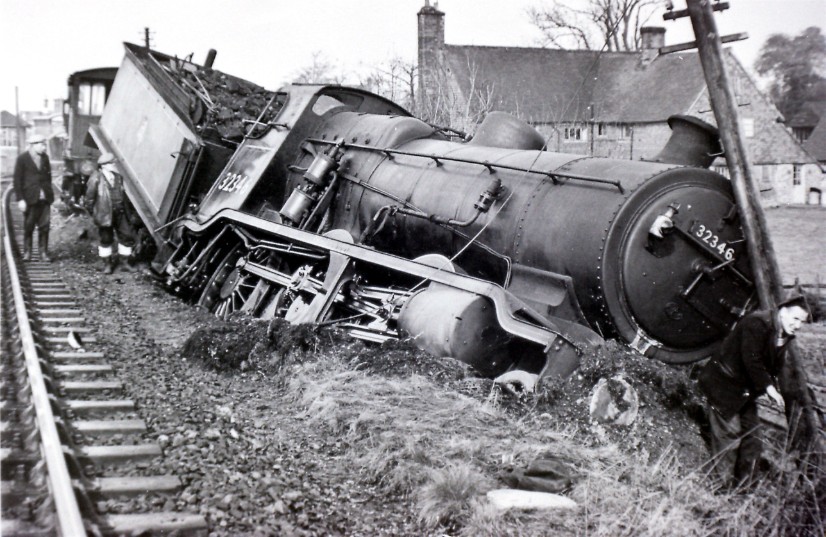
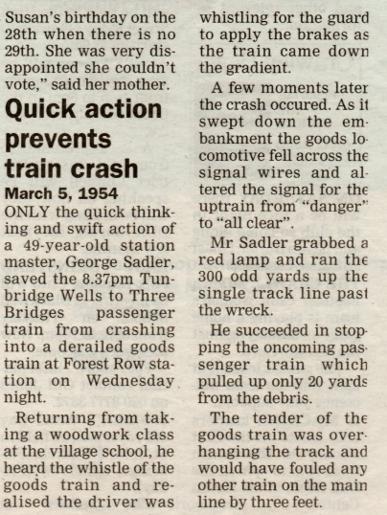
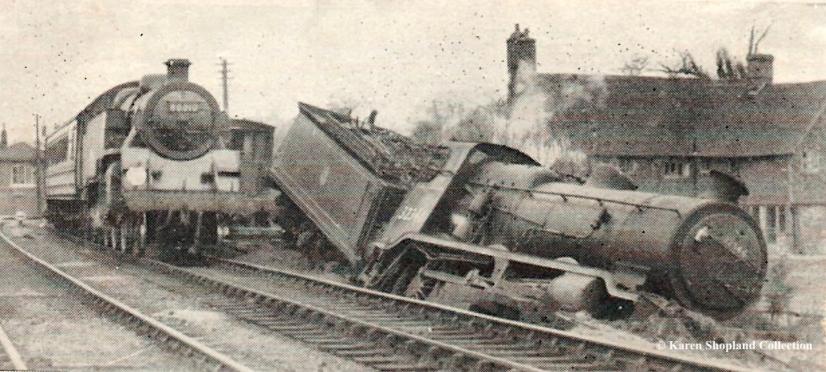
On Friday 3rd March, 1954, Driver Charlie Russell and his Fireman Ron Harper, was descending the bank at East Grinstead towards Forest Row, with a K Class ‘Mogul’ No.32346, and a 800 ton permanent way train, when the train became a run-away. After roaring and lurching at considerable speed (estimated variously from 45 to 60 m.p.h.) through Forest Row station it was derailed by catch-points at the Groombridge end of the platforms and came to a grinding halt on its left side at the foot of the embankment. Probably because of their weight and robust construction the effect on the wagons forming the train was less spectacular than might have been excepted for a high-speed derailment and the running line was reasonably quickly cleared, but the retrieval of the engine was a long and difficult task.
Charlie was exonerated but was never the same man after this incident and shortly afterwards he left the job which meant so much to him.
KAREN SHOPLAND COLLECTION
LOCOMOTIVE JOURNAL
APRIL 1954
W. J. CLEAVER
DISTRICT No.7
extracted from report
Another passenger train derailment at Croydon on February 13th was the subject of a further inquiry by the Ministry. A Littlehampton to London Bridge electric train completely left the track at Windmill Junction. Fortunately, no injuries were sustained by passengers. Our motorman member asserts that the distant semaphore signal was at clear, but the home signal, which was at danger, could not be observed in time to avert the derailment. The guard of the train also affirms that he observed the distant in the off position. However, contrary evidence is forthcoming from the signal department and the difficult task of ascertaining the cause of the derailment is a responsibility of the Ministry's Inspecting Officer.
LOCOMOTIVE JOURNAL
MAY 1954
THE EDITOR'S NOTES
MR. CAMPBELL AND A.S.L.E.&F.
Mr. J.S. Campbell, General Secretary of the National Union of Railwaymen, has contributed to a recent issue of the "Railway Review" an article which purports to deal with "The Wage and Salary Structure," and which is not without interest for locomotivemen. It is so because it throws an interesting light upon the working of the "conglomerationist" mentality.
OUR STRIKE NOTICE
At the very end of his article, Mr. Campbell seeks to belittle the decision of our Executive Committee to withdraw the labour of "Associated" members as from April 24th if the Transport Commission did not by that time produce its promised proposals for new wage rates, a decision which duly achieved the object for which it was taken. We are content in this connection to recount the facts:
(1) that it was arranged at a joint meeting with the B.T.C. on December 22nd that respective parties would table their proposals for a new wage structure;
(2) that this Society thereupon put in its proposals in early January, the N.U.R. following suit in the next month;
(3) that the N.U.R. raised objection to the implementation of the Commission's undertaking to table proposals (despite the fact that all the parties agreed to the adoption of this course);
(4) that on April 2nd, as the Commission's document was still not forthcoming, the strike decision was taken by us, with the result that the B.T.C. proposals were handed to the representatives of the three trade unions at an urgently summoned meeting held on April 7th.
The foregoing bare recital is amply sufficient to put the question into true perspective, and fully justifies the action taken by this Society.
HISTORICAL "FACTS"
Mr. Campbell makes reference to the history of the wage negotiations of December last, and he is now good enough to say that when the Transport Commission "refused to go beyond the flat rate increase of 4s. recommended by the R.S.N.T., the N.U.R. and the A.S.L.E.&F. decided on strike action." We suppose we must be grateful for acknowledgement ent of our existence in this context. The admission has, perhaps, a certain ironical interest for "Associated" men, who have been made entirely acquainted, through the medium of Head Office circulars, with the facts concerning the December dispute; and it cannot be denied that if the full policy advocated by the A.S.L.E.&F. at the joint meeting of the three unions held on December 10th had been fully accepted by the N.U.R., much of the misunderstanding could have been avoided.
The "historical" section of the article goes on to deal with the result of the December strike notice, and in this regard it says: "What happened? Immediately the British Transport Commission gave an undertaking that, provided the unions would accept the 4s., the wage and salary structure would be examined, with a view, firstly, of correcting such anomalies as may be found to exist and, secondly, to give added incentive in those directions where such a step is proved to be desirable, the A.S.L.E.&F. said they were willing to postpone their strike action." He goes on to say that "The promise was robbed of its substance by the forthright qualification of Sir Brian Robertson that it must be supposed that this will produce a concrete result in the terms of a rise for anyone."
The passage which we have quoted is, to put it frankly, simply a case of misrepresentation by selection and omission. We would refer readers to the actual text of the terms of settlement, which will be found in full on page 6 of our January issue. It was solely on the basis of these that the Society's notice to strike on December 20th was withdrawn; in other words, when not only the principle of an exhaustive examination had been conceded, but also (under Clause 4) a firm guarantee obtain that the interim would be on a percentage basis, which, as is so well known, was duly implement as from January 24th last in the form of a 6 per cent. advance.
Incidentally, the nature of assurances given by Sir Brian Robertson in the early stages (which have in subsequent negotiations been referred to by the N.U.R.) exposes the ludicrous unfairness of the quotation which in its correct setting refers, as Mr. Campbell knows perfectly well, solely to the immediate outcome of the preliminary meeting which was arranged to be held before Christmas.
We have deemed it expedient to correct Mr. Campbell's reading of history in these matters; but having done so we wish to inform him that this Society for its part is not going to be drawn into a contest of mutual vilification. Furthermore, this Society, as the proud representative of the overwhelming majority of locomotivemen, is certainly not going to lower itself to running around picking up every little pin pricking allegation which others, for reasons best known to themselves, may throw out against us; because FACTS SPEAK LOUDER THAN WORDS, and the facts are well known.
WAGES POLICY
We therefore turn from Mr. Campbell's "history" to the industry indication which his article gives as to N.U.R. policy for locomotivemen.
Having stated that the N.U.R. is anxious to ensure "that footplate staff get a wage which reflects fairly the responsibility they undertake," he goes on to say: "But the locomotivemen are not the only railwaymen with great responsibilities, and it is the N.U.R. policy that a wage structure which has to remove anomalies and be of lasting value must ensure that the responsibility of every grade is appropriately recognised."
It would indeed be happy augury if the N.U.R. accepted the imperative need for wages rates to be associated with responsibility; but there has been no evidence in negotiations to date to indicate that they have in fact departed from their long established practice of concentrating on the upliftment of the minimum adult rate, In point to fact, they know only too well that it was admitted on their behalf during the December negotiations that they would be prepared to accept a flat-rate increase. Need we say more?
We are criticised in the article because, it is stated, we have stepped up our demand since we applied to the R.S.N.T. last year for a 15 per cent. increase. Mr. Campbell says we are now seeking an increase of 22 per cent., and he chides us on this account. The fact that he thus seeks to admonish us is further evidence of the all grades mentality in its approach to the present situation. The whole plane has changed since R.S.N.T. Decision No.15 appeared. At that time the B.T.C. had not accepted the principle of an exhaustive examination of wage relativity and differentials. Since then, as a result of our stand last December, they have done so; and this Society has consequently put forward proposals which in its view, if adopted, bring about a true readjustment of wage rates, as envisaged by the 1947 Court of Inquiry, and publicly advocated by us for many years.
Thus no charge of inconsistency can be levelled against us. Our proposed rates, which are well known to our members, will stand the most rigorous examination; and the type of criticism which we have just quoted simply proves afresh the fact that the A.S.L..E.&F. AT THIS JUNCTURE IS THE ONLY ORGANISATION PREPARED TO PRESS THE FULL FOR DUE RECOGNITION OF THE JUST CLAIMS OF LOCOMOTIVEMEN. This policy we shall continue to pursue, fortified in these arduous days by the knowledge of the full confidence and backing of the fraternity which it is our privilege to represent.
It is unfortunate that those who shout so much about unity fail to put it into practice; and, having for very obvious reasons deliberately refrained from entering into controversy through the medium of periodicals up to this tie, we will leave the so called disciples of unity to reflect. In the meantime we will carry forward the job of work we have on hand in the interests of the footplate fraternity, and when the time is opportune we shall have much more to say in respect to recent history.
LOCOMOTIVE JOURNAL
MAY 1954
DISTRICT COUNCIL No.4
Bro. A.W. Lennard was in the chair at our meeting on February 22nd, E.C. member Hocking and Organiser Cleaver being present. After the Roll Call the election of officers took place. Bro. ("Razor") Lennard was again elected Chairman. One must give it to him as "Razor" handles evert situation with a serene smile and keeps the Council on an even keel. Bro. Crumpton was again elected secretary; Reg has been doing this job for a number of years now, besides being Branch Secretary at Gillingham, a position he has held for 32 years. This surely must be nearly a record. Well done, Reg! The remaining offices were filled with very little alteration.
Bro. Cleaver reported on the Watford accident with very interesting details. H also dealt with the "nons" question and emphasised the necessity for a tightening up o this matter. He also impressed upon those present the necessity of reporting accidents at once, as this makes the work of the Legal Department much easier.
E.C. Member Hocking then gave his usual informative report. He took the Council through the stages of the wages negotiations, and dealt also with the strike threat, explaining the difference of opinion between the N.U.R. legal advice and the A.S.L.E.&F. legal advice; after adjournment the N.U.R. agreed that the A.S.L.E.&F. legal opinion was correct one. One great point Bro. Hocking stressed was that after fighting from 1947 onward, we had gained the point of relativity. We must congratulate the General Secretary and the E.C. on this as we have at last gained the recognition which is ours by right. Pensions was the next subject, and here one must reverse my last report and it is "Progress Forward." The question of "nons" was an important matter as the E.C. felt that 1954 might well be the testing time, and that in their view it is necessary for an all out drive to rope all into our Society.
Compensation cases dealt with the last meeting brought very interesting figures, the sum obtained for members was just over £5,500, at the cost to the Society of £1,077 7s. 6d. What an insurance!
The following resolution was carried: "That this District Council, following the E.C. Member's report regarding recent and pending negotiations on wages and conditions, supports the action of the E.C., and also pledges support to any action considered necessary to obtain a satisfactory conclusion to the policy and decisions of the A.S.L.E.&F."
F. MILLER
LOCOMOTIVE JOURNAL
MAY 1954
SELHURST
As branch secretary for the past 22 years, Bill Boulton has put in sterling work on behalf of his colleagues and of the " Associated " in general.
The friends he has made in that time are legion. The meetings he has arranged and attended; the thousands of words written in correspondence; the sick visits made; the monies collected for all sorts of charities ; and, above all, the guidance he has given to those of us who contemplate following in his footsteps—all these things give the

KAREN SHOPLAND COLLECTION
Rambler Excursion at Rowfrant 9th June 1954
LOCOMOTIVE JOURNAL
JUNE 1954
SELHURST
Once again it can be reported our Good Friday Reunion was a huge success, thanks to the effort put in by the committee, The Revelaires," who provided the entertainment and band for dancing. We had the pleasure of the company of Bro. Jim Baty, General Secretary, and his good lady, and it was pleasing to see him mixing freely with the "old boys," as he endearingly terms them, and exchanging views after tea.
We intended that Bro. Baty should have an evening out, with " differentials," etc., in the background, and sincerely trust that his general health will be improved to stand the test that is being waged regarding our claim now before the B.T.C. for recognition of the responsibility of our calling.
In conclusion, our best thanks to the donors of prizes for raffle, which added to the success of the evening.
To the branch rooms, chums, and back your officers in their effort to keep the "Flame" alight. The A.A.D. report will be available by the time this reaches your hands. Bro. Pullen will be at your service as delegate.
W. BOULTON
Brian Cook Collection
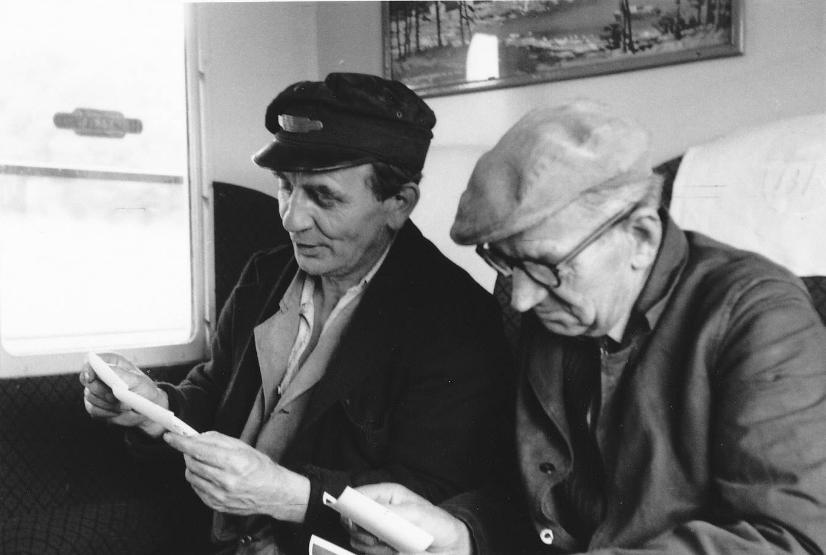
Charlie Cook & Ron “Razor" Reeves
Pass to the Bridges, and yes it would have been Hornby turns, I think it was around the time
we were working two drivers to a turn because of shortage of second men, it usually involved four Duties in the days of ( “dare I say it" ) twelve hours!!!!
Memories Rodney Burstow
Ron Reeves seniority date 09.05.1919 (Horsham). Ron, known as ‘Razor’ was a fireman and driver at Horsham, and one of the ‘Hornby’ men. Ron had some remarkable luck when he was a fireman during the war years, he was the fireman on the train which went into the bomb crater, near the Worthing Road bridge, shortly after leaving Horsham, and was the fireman on the train that was strafed by a German aircraft at West Grinstead, where the driver, Les Ansbridge (20.11.1914) was sadly killed.
Information from Brian Cooke
LOCOMOTIVE JOURNAL
AUGUST 1954
THE EDITOR'S NOTES
"PENSIONS" A REALITY
It would be correct to say Wednesday, July 7th, 1954, was indeed an epoch making date in the transport annal of Britain; for it was on that day that the Minister of Transport and Civil Aviation informed the House of Commons that he had made regulations, establishing as from October 1st, 1954, aPension Scheme, agreed between the Transport Commission and the Unions concerned, in respect of the wages grades in the Commission's employ.
For the information of our readers a summary of the provisions of the Pension Scheme is set out on another page of this issue of the "Journal." It is worthy of the most careful study and consideration by every member of our Society.
It will be be recalled that the Scheme, printed under the title "Outline of a Proposed Pension Scheme for Adult Male Wages Grades," and being the result of protracted negotiations between the B.T.C. and the Unions, was adopted at a Special Assembly of the 1953 A.A.D. held on August 27th last year. The printed report of the Conference proceedings, issued to our branches, embodied a copy of the "Outline Scheme" in full.
following a similar acceptance of the proposals by the other workers' organisations concerned, there has been a period, necessarily somewhat lengthy, in which the Pensions Joint Sub-Committee have been engaged upon the drafting of rules and arranging all the various detailed matters affecting the practical implementation of the scheme.
After the completion of this task came the final submission to the Minister, and latter, the announcement in the House.
We have described the latter event as epoch-making, and we feel it is particularly so as affecting our own Society. For it is, after all, a matter of historical fact that over a very lengthy term of years the A.S.L.E.&F. has sought to secure acceptance of the principle of pensions for railwaymen. It has been not only a long struggle, but also a tough one; because our demand for pensions has never been a ,after of formal lip service. True, it has been an ideal, but not in the sense of being something periodically taken down and given an arising, and then replaced upon the shelf.
Our efforts in this connection were consistently applied, though unsuccessfully, under the old railway companies; and it can and should be recorded that it was this Society which took the initiative in ensuring that pensions became an active issue for the B.T.C. and the former Railway Executive right from the very inception of those bodies. Not for the first time, our grand old Society has been truly the "spearhead."
It is natural that we recall these facts with pride, in commending the Pension Scheme to the favourable attention of our members, and we are reasonably convinces that it will receive their cordial and practical support, firstly, on the basis of the unquestioned value of the establishment of this worthy principle, and also having regard to the outstanding part played by the "Associated" towards its realisation.
LOCOMOTIVE JOURNAL
AUGUST 1954
PENSION SCHEME FOR B.T.C. WAGES GRADES
JOINT STATEMENT BY THE COMMISSION AND
THE TRADE UNION ORGANISATIONS
The British Transport Commission, the National Union of Railwaymen, the Associated Society of Locomotive Engineers and Firemen, the Transport and General Workers' Union, and the Confederation of Shipbuilding and Engineering Unions have reached complete agreement on the terms of a Pension Scheme for the British Transport Commission Male Wages Grades in the service of British Railways, the Docks and Inland Waterways, the Hotels and Catering Services, the London Transport Executive and at the Commission's Headquarters.
The Minister of Transport and Civil Aviation, who announced this in the House of Commons on July 7th, has made Regulations establishing the Scheme as from 1st October next.
The Scheme is in two parts, Section A, the main Scheme, and Section B, which provides additional pensions for senior grades.
The weekly contributions in Section A range from 1s. 8d. at 21 years of age to 2s. 5d. at 54 years of age or over. In Section B additional contributions range from 8d. to 11d. a week according to the age of the employee when he enters the Scheme. In Section A the weekly rate of pension at the minimum pensionable age of 65 will be 30s. after 40 years' member-ship, and in Section B an additional 10s.after 35 years' membership. Both these amounts diminish proportionately with shorter membership.
The main provisions of the Scheme are as follows:
MEMBERSHIP
Compulsory for new entrants to the service; optional for existing employees.
PERSON ELIGIBLE
Section A
Appointed whole time employees age 21 to 45 will join Section A after 12 months' service. Existing staff will have a six months' option to join if they have completed or can complete 20 years' service by age 65.
Section B
Persons joining Section A who are employed in the senior grades listed in the First Schedule of the Scheme.
MEMBERS' CONTRIBUTIONS
Section A - 1s. 8d. a week for entrant at age 21 rising to 2s. 5d. for entrant at age 54 or over.
Section B - additional contribution from 8d. to 11d. a week according to age at entry.
MINIMUM PENSIONABLE AGE: 65.
PENSION AT MINIMUM PENSIONABLE AGE:
Section A - 30s. a week after 40 years' membership, diminished proportionately for shorter membership.
Section B - additional 10s. a week after 35 years' membership of Section B, diminished proportionately for shorter membership.
BACK SERVICE CREDIT
Existing employees aged 52 and over joining Section A will be given credit (at the cost of the Commission) to secure a minimum pension of 9s. 9d. a week at age 65.
DEFERRED RETIREMENT
Normal pension increase by 1/15th of Section A pension and 1/10th of Section B pension for each year's service after 65 up to a maximum of 5 increases.
ILL HEALTH RETIREMENT
After 10 years' membership, proportionate pension based on years of membership; under 10 years' membership, return of contributions with interest.
DEATH BENEFIT
Lump sum payment representing approximately returns of member's contributions with compound interest.
TRANSFERS
A transfer value will be paid to the salaried staff scheme when a member of the wages grade scheme is promoted and enters the salaried staff scheme. A transfer value will also be paid where a member with 10 years' membership leaves the Commission's service and enters other employment in respect of which there are reciprocal arrangements for transfer of pension rights. There is provision for acceptance of transfer values from other schemes and for the employees concerned to enter the Commission's scheme with waiver of age limit.
ADMINISTRATION
The scheme will be administered by a Central Committee of 20 persons, 10 appointed by the Commission and 10 nominated by the Trade Unions.
REVIEW
In the event of change in National Insurance pension conditions the Commission are to review the scheme and if necessary request the Minister to amend the rules.
SET OFF OF EXISTING WAGES GRADES PENSION RIGHTS
Any benefits which the Commission are at present liable to provide under existing wages grade scheme or customary practice for existing staff who join the new Scheme will be set off against the Commission's share of the benefits due to those persons under the scheme.
DIVISION OF COST
Apart from the cost of back service credit, which is borne by the Commission, benefits are provided as to one half by the employee's contributions and as to one half by the Commission The cost of administration will be borne by the Commission.
LOCOMOTIVE JOURNAL
AUGUST 1954
DISTRICT COUNCIL No.4
The council met at Redhill on May 17th, Bro. A.W. Lennard in the chair. E.C. Member Hocking and Organiser Cleaver were present.
Organiser Cleaver dealt with the membership figures in great detail, pointing out the black spots and asking the Council to see what could be done in the matter. He also dealt with the Stewarts Lane Transport Inquiry about a cleaner of 17 who was killed going off duty, and gave details of the complications that had arisen.
He also gave a report on the inquiry on the Windmill Bridge Junction derailment, etc., and stressed the importance of quarterly returns being remitted to H.O. within the specified period.
E.C. Member Hocking gave another informative report dealing with the wage negotiations, this was a grave situation which needed the attention of all members. He told the Council it might become a testing time and urged all present to be prepared for any action the E.C. deemed necessary. Strong words surely, but very necessary, and all members present, after hearing his explicit statement, agreed that we must be prepared to back the E.C. to the utmost extremity. He also dealt with the new Pension Scheme, giving details of the composition of the Negotiating Committee; optional joining period; staff awaiting appointment to light duty, etc., etc.; and said that the Scheme had gone to the Minister for his final approval. Bro. Hocking also gave further details of the new vision test, of the negotiations dealing with the different clause as previously submitted by the Transport Commission and this showed a great improvement on pervious report; details of men returning after illness or accident were also explained. Details of compensation cases gave figures which only go to prove the amount of good work done by the Society in this direction.
A good meeting on the eve of the A.A.D.; and now we look forward to that report.
F. MILLER
LOCOMOTIVE JOURNAL
AUGUST 1954
LONDON BRIDGE

LOCOMOTIVE JOURNAL
SEPTEMBER 1954
THE EDITOR'S NOTES
WAGES NEGOTIATIONS
A.SL.E.& F. branches have been advised, by means of Head Office circulars, of develop-ments in the wage negotiations set up under the Terms of Settlement of last December's dispute. They are therefore aware that due to the wide difference between the claim made by the Organisation and the offer made by the Transport Commission, the Executive Committee have rejected the said offer as being totally inadequate.
No pains have been spared to impress upon the B.T.C. the bitter resentment of the membership in connection with the Commission's failure to recognise the locomotive man's rightful place in the railway wages structure. The current situation is, as has also been notified to branches receiving the most earnest attention of the Executive Committee with a view to further prosecution of the class on behalf of our members, who will continue to be kept fully informed of the position.
RAILWAY REORGANISATION
As we went to Press last month the Government's White Paper on railway reorganisation, arising from the 1953 Transport Act, made its appearance, and we published an extract of its provisions for the information of our readers.
The preamble to the White Paper indicates that "In accordance with Section 17(1) of the Act of 1953 the Minister has consulted with such bodies representative of classes of persons likely to be specially affected by the Scheme, as he thought fit, and with the National Coal Board."
"GENERALLY ACCEPTABLE"
Then follows the statement that "Thos consultations have shown the Commission's Scheme to be generally acceptable." This to say the least of it is a surprising claim to make, when we reflect that one of the interested bodies consulted was the T.U.C., which commented adversely and forthrightly on the proposals in draft form. The scheme as published, however, shows little change from the draft submitted to the T.U.C.; and it is just another example of the Tory mentality that the Minister can still blandly hail as "generally acceptable" a document definitely NOT acceptable to the body representing the organised workers of this country!
AREA BOARDS
There can in fact be no doubt that the Tory legislation which brought the White Paper into being represents nothing more or less than sheer expression of spite against the Labour Movement and its policies. The strange proposals to set up area boards is one to which (as we made plain at the time in the appropriate quarters) we are strongly opposed. If put into operation it will inevitably add to the Commission's costs without providing any compensation whatsoever in the shape of increased efficiency.
The B.T.C. are to continue, says the White Paper "in principle" to reserve to themselves "certain specific matters (such as the design, manufacture and standards of maintenance of locomotives, rolling stock, permanent way and signalling; labour relations of a major character; general level of charges; financial control in its broader aspects; higher appointments; the policies and principles to be adopted in railway operation; the inter regional distribution of wagons; and commercial policy in general and national negotiations in connection therewith) in so far as the Railway Executive had previously been concerned with them."
It is, of course, obvious that these are indeed functions which the Commission must retain in its hands if British Railways are not to succumb under the childish meddling of Tory politicians. On the other hand it is equally clear that, given limitations of this character, the matters to be dealt with at "area" level must be confined in practice by day-to-day questions with which practical railwaymen are best suited to deal. Thus it is that we denounce the setting up of boards in the areas as utterly needless and a completely unjustifiable waste of hard earned money.
ADEQUATE MACHINERY ALREADY EXISTS
A further feature which should be borne in mind is the fact that Labour's Transport Act of 1947 provided entirely adequate machinery through which outside influence can find desirable and indeed necessary expression, in the form of the Central Transport Committee, the Transport Tribunal, and the Transport Users' Consultative Committees.
PLAYING AT TRAINS
As to the proposals to encourage regional rivalry, e.g., by instituting distinctive uniforms, and, possibly, varying the colours of rolling stock, we subscribe to the view expressed by the T.U.C. that this is simply "playing at trains." In our opinion, considered as an attempt to foster loyalty, it would be impossible to envisage a more hare-brained, grotesque and stupid approach. to a very urgent problem, a problem which has its roots far too deeply set to be touched by any such trivial and nonsensical fripperies.
WHOSE RESPONSIBILITY?
The Commission itself had no option but to try to evolve a scheme on the lines laid down by the Tories in the 1953 Act. The responsibility for these proposals rests in fact wholly and solely with the present Government. The workers in all grades of the service will unfortunately have to put up with this amateurish and ridiculous "tinkering" with the industry until such time as a political change of heart is manifested in the country by the return to office of a Labour administration. May it be an object lesson to all of us to do our utmost to bring about that change, in unmistakable fashion and at the earliest possible date!
LOCOMOTIVE JOURNAL
SEPTEMBER 1954
LONDON BRIDGE
DI DOWSETT COLLECTION
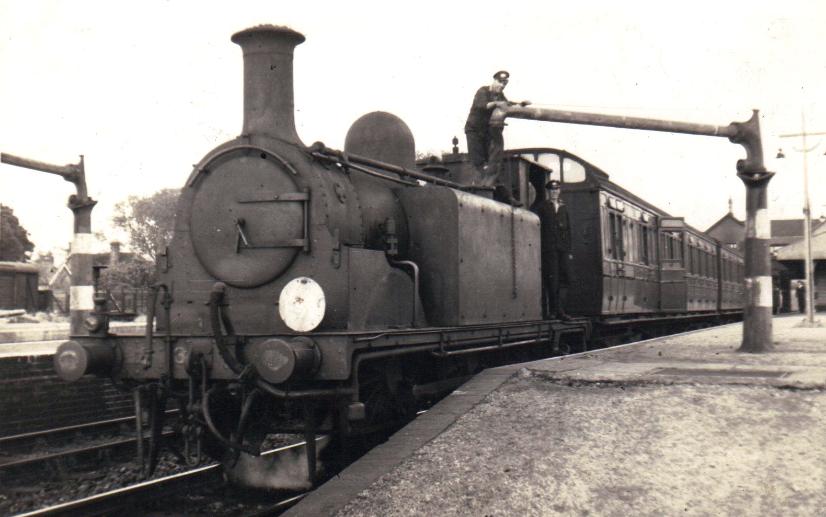
Driver Fred Diplock & Fireman Dennis Ward taking water at Eridge
LOCOMOTIVE JOURNAL
SEPTEMBER 1954
SELHURST
Yet another A.A.D. report has been received. This one for 1954 given by Bro. Don Pullen certainly revealed some lively times. As a matter of interest Don has given 14 reports, which shows how keenly interested motormen have been in the southern items that were discussed, particularly promotion, transfer, redundancy arrangements and negotiating machinery.
If we are to get anything out of Conference decisions. branches will have to bombard the E.C. with their ideas for improvement in time for the 1955 A.A.D.
We can compliment ourselves in having a real live delegate in 1954.
The recent case of one of our members being suspended and returned to loco as punishment for allowing an unauthorised person to handle the controls, must be a warning to us all not to take chances.
Bros. Cleaver and Newbegin both at the formal interview and appeal failed to get the decision altered despite their excellent advocacy.
On the lighter side, members of Selhurst branch can give any challengers a good game at golf, bowls or cricket. Are there any challengers?-
Bill Boulton.
LOCOMOTIVE JOURNAL
SEPTEMBER 1954
NATIONAL CONDITIONS OF SERVICE BOOKLET
sir, The National Conditions of Service booklet supplied at a small sum by the A.S.L.E.&F is one which every Enginemen should have. Just recently alterations and additions were supplied to those who had this booklet, thus bringing them up-to-date.
In these days of "petty officialdom," false economy, and violations of our conditions of service, under the guise of efficiency, it is very necessary that we all make ourselves more acquainted about that which we are justly entitled to, thus preventing those on the manage- ment side from trying (in some cases) deliberately to distort our agreements.
S.F.G. CHEAL
St Leonards
RAILTOUR 4th OCTOBER 1954
WORKED BY THREE BRIDGES
DRIVER G. TAYLOR (FORMERLY OF EBNE)
& FIREMAN DAVE SHOPLAND
Photo from Karen Shopland Collection