LEATHERHEAD A.S.L.E.&F. BRANCH
The Leatherhead Branch of A.S.L.E.& F. was founded in 1947. The branch is thought to have cover the three Motorman depots within the area. The two depots on the South Western at Leatherhead and Effingham Junction. At Effingham Junction there was also a very small Brighton Section (Central) depot which is thought to have been incorporated into this branch.

LOCOMOTIVE JOURNAL
FEBRUARY 1947
THE EDITOR'S NOTES
ABSENTEEISM, LONG HOURS,
AND WORKING CONDITIONS
We join with those who are expressing concerning at the continuance of degrees of "Absenteeism" at a number of locomotive depots. We do this because we believe that all those who feel a sense of responsibility for workers in the Railway Service recognise that it is a condition of things which must be examined.
LOCOMOTIVE JOURNAL
FEBRUARY 1947
TUNBRIDGE WELLS BRANCH
Sir.- Of the eight Labour members of the Tunbridge Wells Borough Council, Five are railwaymen, all members of the loco. staff. Associated members: Bros. F.G. Robinson (Branch Secretary), F.E. Elmer (Branch Chairman), C.R. Cornford (Check Stewart and National Health agent). N.U.R. members (shed staff): Bros. D. Hutchings and E. Kennard.
Considering the total staff at this depot numbers only 90, you will agree this a fine show. These five fellow-workers, together with their Socialist colleagues on our local authority, have a big job in hand, and through their untiring efforts are making their weight felt in this bastion of Toryism.
We of this branch should like this opportunity to wish all those members of our organisation who have taken up the fight on our behalf success in their efforts.
V.A. Rumley
LOCOMOTIVE JOURNAL
MARCH 1947
THE EDITOR'S NOTES
COAL AND TRANSPORT
At the time of going to press the question of the supply of coal is paramount in the minds of most citizens of the country and is hitting the headlines of all newspapers. There is little doubt that the climatic conditions which we have experienced during the past five weeks have served to emphasise the need for the greater production of coal. This, we believe, will be recognised by all progressive minded persons. Obviously it has not been easy to recruit new men as miners. For this there are many reasons and causes which we do not propose to enumerate here. The facts demonstrate that more men must be induced to enter the mines for the purpose of getting coal, and this inducement will only be possible if the conditions of work for the miner are considerably improved. Rates of pay and hours of duty obviously should be such as can be looked upon as being satisfactory, and we commend the claim of the miner to the sympathy of all right thinking people.
LOCOMOTIVE JOURNAL
MARCH 1947
TUNBRIDGE WELLS BRANCH
We were pleased to welcome Bro. H. Bidwell, our executive member, on Sunday, February 10th, at a special meting held at the Wheatsheaf Hall.
Bro. F. Robinson, in the absence of our Chairman, presided over a fair attendance.
We were given an exhaustive report on the recent A.A.D. Conference and the National Programme, and Bro. Bidwell gave an interesting talk on the Nationalisation of the Railways. He gave satisfying answers to our members’ many and varied questions.
Bro. R. Cornford proposed a vote of thanks to our visitor, who, we hope, will visit our branch again on some future occasion.
Congratulation to Bros. Robinson and Elmer on their recent success in the Municipal Elections.
For attendance at our branch meeting we still rely on the few stalwarts. New faces, will find a welcome if they will make special effort to attend.
K.A. PASSMORE,
Asst. Branch Sec.
LOCOMOTIVE JOURNAL
MARCH 1947
PAGE 75
SELHURST BRANCH.
It is the duty of all men to attending meetings when available. On Sunday, February 2, we organised an open meeting for the purpose of gleaning knowledge on the suggested 88 hour fortnight. In the absence of the E.C. member, we had the pleasure of Bro. Cleaver (Organiser), at very short notice, to address the meeting. Although not being well informed on the latest negotiations, he was able to give those present food for thought on policy of our Society leading up to the present suggested step. At the time of writing, our members are not convinced that it will be beneficial, seeing that we already work 26 Sundays each year, and our duties are all passenger work. I would recommend that all readers of the Locomotive Journal pick up February’s issue and read again the General Secretary’s notes, Bro. J.F. Sharman’s report, Scottish Opinion, Bro. Simer's article, Bro. Monslow on Nationalisation, and last, but not least, Bill Juke’s Call to Action. All, in their way, should make us realise what is at stake, and from now on resolve to work as we never worked before for the ideal of us all, which is to provide for a better and fuller life. no periodical, magazine or journal contains such a wealth of sane writing for the price.
W.B.
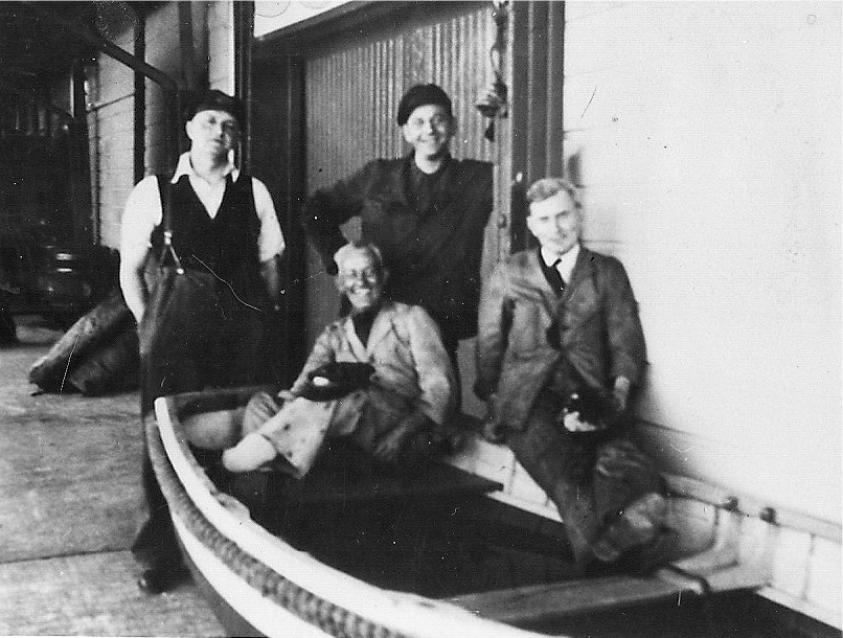
Ron Terrill Collection
L~ R: Driver Alf Charman (13.1918) & Fireman Charlie Evans,
Driver Earn Eacott (5.11.1917) & Fireman Tim Norman
Photo taken at Newhaven Marine station
Extracted and adapted from
Newhaven Branch Special Meeting
Sunday April 20th 1947
Bro. W.J. Cleaver in attendance
The speaker pointed out that it was apathy amongst the rank and file that really caused the percentages reductions to take place in 1930-1931 and took the Society until 1938 to recover that which they had lost, it took until 1938 to really get that which had been won in 1920! Bro. Cleaver pointed out that advances must be made there was no standing still, and if advance was not made things went back, this was retrograde and the aim and ambition of all was for advancement and it was only by attendance at meeting that resolutions could be made and forwarded to the Head Office for the guidance of the Executive Committee, and the formulation of a programme.
This was a call to all members especially the younger members.
At the close of his address Bro. Crossburn asked for suggestions of any notice and so no member to ask any questions, Bro. Cossburn asked if any information was forthcoming re the proposed National Agreement and what Railway had been made.
Bro. Cleaver replied that another meeting pending and he was no better informed than us.
Secretary asked Bro. Cleaver to give on the political fund which Bro. Cleaver did explaining the aim for political representation on and only the Government but all the originating bodies that will be involved in the National Railways etc.
Previous to terminating his address. Bro. Cleaver to the function that will be required of the L.D.C.s and Sectional Councils insofar as the Management of and operation of the Transport by rail of the National Transport system and pointed out that foresighted and systematized policy, will be required to make publicly owned railways a true success.
LOCOMOTIVE JOURNAL
MAY 1947
THE EDITOR'S NOTES
DISCIPLINE - SUSPENSION AND LOYALTY
On March 22nd, motormen on the Eastern Section of the Southern Railway demonstrated their sympathy for a colleague who was suspended on that day as a result of a decision reached under the Disciplinary Procedures, by themselves declining to appear for duty. This action was unofficial and against the advice of Society headquarters, created tremendous inconvenient or many thousands of the travelling public, and, of course, hit the headlines of the London daily Press. The reports on the incident were in the main quite factual, and to that extent could in no way be objected to. We do not propose to enter here into the merits of incident which resulted in this drastic action. It is, however, impossible to dispel the admir-ation which has been expressed in many quarters of the undivided loyalty and self sacrifice, even though misplaced, which was shown by all concerned to a colleague. On the other hand, those who have to deal with these matters officially must reach their conclusion on all the evidence which is presented and give their advice accordingly, and they naturally desire to see the loyalty to the Society being given first preference at all times. We do not say this with object of enforcing hard headed dictatorial discipline, but because a measure of disciple is essential to the retention of the power of a union with those with who they negotiate and deal from time to time. Indeed, just as in a well ordered society reasonable discipline comes imperative, as too does it apply in the trade union world.
LOCOMOTIVE JOURNAL
JULY 1947
ST. LEONARD’S BRANCH
On Friday, May 30, a special branch meeting was held in conjunction with the A.A.D. being held at Hastings for the first time in the history of the Society. Members from Eastbourne and Ore joined us to welcome our general secretary, Mr. W.P. Allen, also Bro. H.E. Bidwell, president of the executive committee. The meeting was very well attended by the three branches. Delegates of the A.A.D. also visited the branch to show their appreciation for all that had been done to make their visit South a happy one.
Bro. G. Wright of Wood Green spoke of the L.P.T.B., and Bro. E. Peachey of Stratford gave a short address on the L.N.E.R. matters.
Then the president of the E.C. gave a lengthy address on the National programme as put before the companies recently, and now before the Court of Inquiry.
Bro. W.P. Allen, general secretary, received a great welcome on rising to speak for the first time in our branch room, also this being his first visit to Hastings.
Bro. Allen spoke on Nationalisation of the railways, and of the different ideas of line promotion of footplate men.
Members present then fired questions at the general secretary, to which he replied, and aftr a very good meeting, thoroughly enjoyed by all, the end came all too soon for some.
We at St. Leonards hope that the A.A.D. will again visit us in the South at some time future time, as we can assure the best of weather, as our branch chairman forecast on the opening of the conference.
D.W. Sargent
Branch Secretary
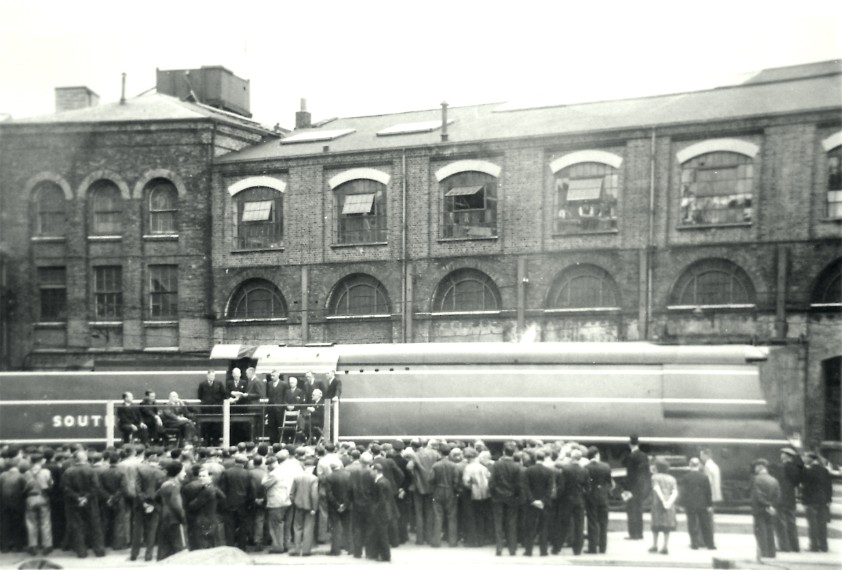
Fighter Command 21C164/34064
The 1000th locomotive built at Brighton locomotive works since 1852, new to traffic 14th
July 1947. After trials, fitted with first of the modified 'V' wedge shaped cabs, with two side
windows (three became standard later). New to Ramsgate shed. Formally named at Waterloo
Station by Sir James Robb 11 September 1947, along with Winston Churchill and Lord
Dowding. Renumbered 34064 3rd June 1948. Unrebuilt; fitted with Giesl oblong Ejector and chimney April 1962, but this had no particular effect on the Bulleid's already excellent
steaming abilities. Standby engine for Sir Winston Churchill's funeral train in January 1965;
held in steam at Staines, but not needed. Withdrawn from Salisbury shed 22nd May 1966,
stored in Basingstoke yard September 1966 and scrapped by Birds at Bridgend November
1966. Final mileage 759,666.
LOCOMOTIVE JOURNAL
SEPTEMBER 1947
THE EDITOR'S NOTES
THE PRESENT CRISIS
We feel compelled to make reference to the above in spite of the fact that the subject has been filling the headlines of the Press of the country for several days. Our reason for so doing is because of the effect which the Government policy may have upon railwaymen in general in the coming months.
Only a person blinded by prejudice (or. should we say, a Tory politician) would be doing any- thing under the present circumstances to create undue difficulty for the Government in the task which lies before them. We find it paradoxical and, under other circumstances, perhaps amusing, when we recognise that first, Labour's opponents suggest that the steps outlined by the Prime Minister to Parliament in his statement on the Economic Crisis are not sufficiently drastic. This is followed by other statements on the Supplies and Services Bill, which is to give the Government policy, and it is then said by the same critics that this Bill gives too much to the Government. Either we intend to face up to the circumstances which surround us, and these are certainly not of our choosing, or we enter a period of acting in a manner which can be described as merely "drifting." Does this country desire to be a pawn in the hands of the United States of America, or, indeed, of any other country? We think not. That being so, we must decide how to make ourselves independent of any other country, but at the same time to maintain friendly relations with them all. This is behind the policy of the Labour Government. If, as they must, they take powers to make effective their own proposals, how can we complain? All that is being done on the Supplies and Services Bill is to the Govern-ment to take more serious steps than are at present outlined IF THEY THINK THIS NECESSARY.
Whether such steps will be necessary will largely depend upon the approach which the nation makes to the Government's request.
We in the Trade Union world are always diffident of surrendering privileges or right which we have obtained by sheer hard work or endeavour, even for a limited period of time. No one denies that under present circumstances too many people are employed in industries and services which are not essential. If by a modified Control of Engagement Order the avenues of recruitment of additional workers to these industries are closed, can there be anything wrong with this? Such an innovation presupposes that the wages rates and conditions of work in the essential industries must be placed at a reasonably high level. The If a policy of this character succeeds, the absolute direction of labour as we understand it will not be necessary.
LOCOMOTIVE JOURNAL
SEPTEMBER 1947
THERE WAS A WAR-TIME COAL SHORTAGE
BY JANET GREY
OF THE "DAILY HERALD"
A question often asked today is: Why should there be a coal shortage now, although there wasn't any coal shortage during the war?
LOCOMOTIVE JOURNAL
DECEMBER 1947
PAGE 309
SELHURST BRANCH
Since our last report we have had visits by Bro. Cleaver (Organiser), to address members on that vexed question of housing. Whilst the present system gives only limited scope to him as Liaison Officer, our members are satisfied that motormen are at least having consideration alongside other key grades.
Rest Days! Implementation of same has revealed that the Electrical Section is working very near the bone for manpower. This position will have to be closely watched by Sectional Council.
We had the pleasure of the company of Bro. W. Isaac, Chairman of Sectional Council Employees’ Side, at our October 27 meeting, his short address was appreciated by all present.
All men in Steam and Electrical branches in electrified areas are asked to take note of the promotional machinery that will soon be a national agreement. There are some far reaching changes. Go to your meetings and keep in touch with current affairs! On the lighter side, we had our first Social and Dance on October 21. Results were very encouraging. Our best thanks to all who made the evening successful, including Mrs. and the Misses Boniface and Bro. Mutter for raffle prizes - and to our colleagues from Wimbledon and Norwood Junction for their support. Don’t forget Carnival Dance, December 28! let’s have a “Bumper” evening together.
W.B.
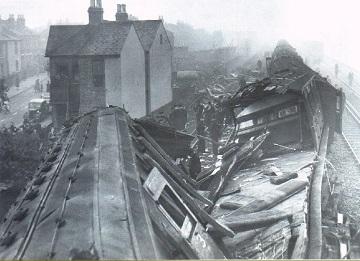
Railway accident on the
Southern Railway
Brighton Section
PHOTOGRAPHER UNKNOWN
South Croydon 24th October 1947
Involving Motormen H. Goldsmith & A. Clack Depots unknown
SEE SUB PAGE
On Sunday November 9th, 1947, saw the opening of the Leatherhead branch of A.S.L.E.&F.
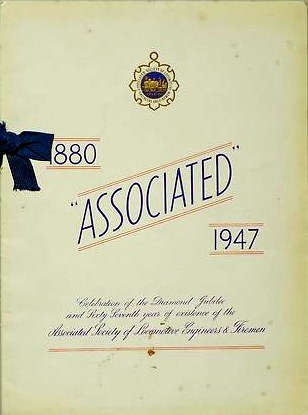
The Diamond Jubilee Celebrations Programe
Celebrating sixty-seven years of ASLEF