Locomotive Journal
January 2002
Defensive Signalling
Over the past few years drivers have all been well aware of the dangers of complacency when driving in any conditions, even more so with the highlighted safety situations that have made the national tabloids and documentaries on television.
Drivers are constantly being reminded that defensive driving is the only way to drive, especially in the leaf fall seasons. Now, I'm not saying this is a bad thing, on the contrary, the more reminders the better, but what reminders do the signallers get in regards to defensive signalling.
Correct me if I'm wrong, but some of the signalling practices seem a little strange and I'll give you some examples.
A rather steep declining gradient with a station on it and a level crossing at the end, the train in question has to terminate at the station and make a return journey, it's slippery, the sandite train hasn't been down. Now the logical practice would be to close the level crossing until the
train has stopped then open the crossing when the signaller knows the train is safe and at a standstill, rather than having the train slip through. We as drivers are familiar with the term
belt and braces at red signals, well shouldn't the self-same thing apply to signallers in this situation, all for the sake of stopping the traffic for a few moments.
Another situation I find difficult to understand is the controlled signals at some junctions and other controlled places on the network, why is it when you are driving along and you start to check down your speed at two yellows the wheels on your train have "picked up" you are now trying to bring your train under control by using skills that you've learned with
experience and you've just slid through the single yellow, the red is in sight and is closing on you but you know that you will stop short of the red because your technique hasn't let you down, as you come to a halt the signal turns green.
Maybe, maybe not there was a train movement across the junction in front of you - the only person who would know this would be the signaller. My point is that if it is not necessary to check the train down why not clear the pathway for the train instead of putting the driver through unnecessary stress in slippery conditions, especially if there are no movements in front of him/her. A drivers' route knowledge should tell him/her whether they need to slow down for speed restrictions or crossovers.
Most drivers are professional enough to realise that defensive driving is the only way to drive. What about signallers - are they professional enough to help drivers with defensive signalling? It would be a shame if a driver slipped through a red signal only to find out it was unnecessary.
Mick Pollard
Three Bridges
Railway accidents on
Connex South Central
Locomotive Journal
April 2002
Leonard Leach
Selhurst
My father, Leonard Allan Leach, was a driver based at Tatttenham Corner, Selhurst depot, until his retirement in 1992. He had served British Rail for 49.5 years, originally based at St. Leonards in the steam days.
He died on October 22 2001 after a brave battle against cancer and is survived by his wife Ann. I would be delighted to hear from any of his old colleagues at ‘Sunnyside’, Woodcote Road, Forest Row, East Sussex, RH18 5AP.
Geoff Leach
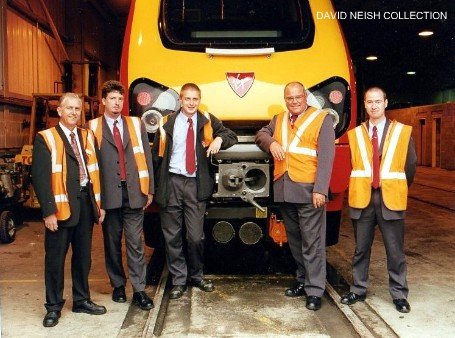
Left- Right: Graham Hussey (Depot Manager), Paul Fish (L.D.C.), Andy Gregg
(L.D.C.), Malcolm Bradford & David Neish.
Photo was taken at Virgin's new maintenance shed at Three Bridges c2002
Locomotive Journal
April 2002
South Central
A new Union Learning Fund initiative “Passport to Progress” is underway on South Central.
The project aims to make learning interesting and easier to access. The project will therefore
focus on workplace programmes for personal development, including life skills and on line
learning. The initial stage includes two company learning centres with access to the Internet and on-line courses through Learn-direct.
A network of learning representatives will also be trained. Information will be sent out to all employees on South Central by the ULF Lifelong Learning Manager, Susanna York, who will be working closely with the ULF teams from the rail unions. The first course will run in Brighton for five consecutive Fridays, commencing 26 April 2002.
Locomotive Journal
May 2002
REDHILL
The March meeting opened with G Vickers in the chair. He welcomed S Weller, company
council, to the meeting. We had the usual reports with the H&S rep, who has written a letter of complaint to management about their lack of action on his reports. Management seem to have responded positively.
We had a company council report, which included our pay offer, and a report on the new
377s unit, which the council are very impressed with – let’s hope they work – with questions after.
We then had a District Secretary report. A motion was passed that a letter of support be sent to our brothers in District no.2
Then Bro Weller presented to Bro Dudley after 49 years 10 months his retirement certificate. We also had three new members accepted. Meeting closed.
D Heydon
Branch Secretary
Locomotive Journal
May 2002
Thanks
I would like to extend two big thank-yous. The first to everyone who encouraged, supported and voted for me and helped me to achieve a delegate's position for the Women's TUC conference.
As a first time delegate I was both excited and apprehensive. I didn't realise just how many
fringe meetings you can fit into one evening. I did make a speech supporting a composite
on work/life balances. I have never been so scared in my life, but I did it.
Once again my whole-hearted thanks to everyone, especially my fellow delegates and friends,
sisters Marion Butcher (LUL), Pauline Cawood (Arriva) and Linda Ferguson (Scotrail).
My second vote of thanks goes to my family and friends, who have helped me get back on my feet and back to work.
Thameslink gave me a lot of support, as did ASLEF. My partner Bill Rutter coped with
everything I went through and was my pillar of strength.
Thanks to Marion Butcher and Bev Batchelor who came down and supported me. A special
thanks to tutors Rob Hancock. and Martin Porritt from the TUC who encouraged me with course meetings and outings. I could go on, but where would I stop?
The special people in my life know who they are – so thank you all.
Dawn Vallance
Brighton
Locomotive Journal
May 2002
Bob Derbyshire
Three Bridges
It is with a sense of both shock and sadness I write about the untimely death of Bob, at the age of 49. He started on the railway at Norwood Junction in 1970 and duly progressed to being a driver at Coulsdn North in the mid-1970s. After the closure of that depot in August 1983, Bob transferred to nearby Redhill, where he worked o both diesel and electric traction.
About three years ago he made his final move to Three Bridges, where I understand he settled post-privatisation on South central.
Bob was a solid supporter of ASLEF, indeed a good man to have during the 1982 strike when we opposed imposed flexible rostering. His great love was coaching stock and older EMUs, and Bob was not only involved with preservation as a long-standing member of the Bluebell
Railway, but also a very skilled railway modeller.
I am sure I speak for all the Coulsdon men, who are now spread from Scotland to Plymouth, in expressing sincere condolences to Bob's friends and family.
Brian Denton
Colsdon North LDC
Locomotive Journal
June 2002
Tabloid reporting
I have just picked up my local newspaper to find the details of an incident involving a colleague at my depot has been spread across the front pages.
The only way that tabloids such as these can get certain information is by a person directly related to the company divulging sensitive logged reports and paper work. I would like to
apologise to the well-respected driver on behalf of the decent drivers and staff associated with the dept.
The action of this individual(s) are nothing less than malicious, back-stabbing, bloody-minded ignorance, and I hope that when they eventually catch up with the big-mouthed traitor(s) they severely reprimand them.
Drivers that are involved in such incidents regardless of whose fault it is should be protected from the likes of the media and staff leaking confidential reports for their own self-gratification.
In times of such media attention, because of past experiences, staff should be wary of tabloid journalists fishing for stories to undermine and destroy public confidence in our railway.
This disgusting display and blatant attack on our colleague at Three Bridges just goes to show that even some so-called work-mates are willing to prostitute their selves to stir up bad feeling throughout the company.
Mick Pollard
Three Bridges
Locomotive Journal
June 2002
Thanks
May I through your letter columns thank all Victoria central and eastern drivers and other
members of staff who contributed to the branch appeal for driver Andy Martin of Gatwick
Express.
Andy has been off sick for some time and has recently undergone keyhole surgery on his
heart. Andy should have been covered by an insurance policy put in place by Gatwick Express - this was not the case, the policy had been allowed to lapse.
I must thank again all members who contributed. It was good to see that although working for
different TOCs they raised £572 which I was able to present to Andy's wife.
Ken Heydon
on behalf of Battersea Branch
Locomotive Journal
June 2002
I would like to thank all those branches that supported me in my successful election as the
southern area delegate to this year’s ITF Conference.
Contributions made at this years conference and at the ASLEF International fringe meeting highlight how important it is that we are involved beyond our immediate borders. Capital organises on a global scale, and so must we as a Trade Union.
Once again, thank you colleagues for this opportunity to represent you and our union at this important conference.
Simon Weller
Brighton
Locomotive Journal
July 2002
ASLEF ELECTIONS
Sean Brady has been elected as Executive Committee member from District No.1, succeeding
Andy Reed.
The Executive Committee has also set in hand the election of the union's national organiser, a new position enshrined in the rule book adopted at this year's Annual Assembly of Delegates. Nominations have been sought, to be returned no later than August 1.
Locomotive Journal
August 2002
TPWS intervention over drugs and
alcohol screening at South Central
In the July session, the Executive Committee gave consideration to a report from the South Central Company Council and the District Secretary, District No 1, concerning South Central’s decision, without recourse to the Company Council, or any attempt by management to negotiate with ASLEF, to undertake drug and alcohol screening of all drivers involved in TPWS interventions at signals, whether a signal is passed at danger or not.
Drivers would also be screened at buffer stops where the TPWS has been modified irrespective of whether the buffers are struck or not. (South Central have yet to decide what
they intend to do with TPWS activations at permanent speed restrictions.)
On 19 July 2002 the General Secretary issued the Managing Director, South Central, with statutory notice of our intention to ballot our members for industrial action.
Locomotive Journal
September 2002
South Central industrial action resolved
On 30 July 2002, Graham Morris, District Secretary No.1 and the South Central Company Council met with Mr David Franks (Managing Director) and Mr. Nick Mitchell (Human Resources Director) of South Central in response to their proposals to screen drivers involved in TPWS interventions at signals for drugs and alcohol irrespective of whether a signal was passed at danger or not, and ASLEF’s decision to ballot driver members for excessive speeding or a number of TPWS interventions during a duty.’
The above agreement is a significant step forward from management’s original draconian proposals and represents a victory for common sense. The agreement will ensure that the practice of screening members irrespective of the full circumstances – will cease. Accordingly, the ballot for industrial action was withdrawn. Agreement was reached to resolve the issue based on the following form of words:
‘Drivers will not be drug and alcohol tested following TPWS interventions unless a
SPAD occurs or the driver has acted negligently i.e. All members on South Central should be congratulated for the solidarity they have demonstrated with their ASLEF negotiating team –
thereby allowing this matter to be resolved in the best interests of the membership.
Locomotive Journal
November 2002
Unity is strength
At a recent branch, meeting the EC member (District 1) and National Organiser elect, Andy Reed reported on the First North Western dispute. The bullying double dealing and downright management lies sounded very familiar to those of us whom undergone the ’Connex Experience’. Connex South Central came to the railway industry with no intention of improving the passenger’s lot, let alone the staff’s conditions. In fact, they came with the
declared desire to “break ASLEF”.
We stood together, weathered the attacks, organised, agitated and kept united.
Some of the employer’s tactics were to denigrate the representatives and attempt to divide the members.
They attempted to harass and intimidate the activist by invoking MFA, poor performance and harassment procedures and that good old standby “unfair dismissal”.
The fight went on from 1996 to 1999, when their bid to renew the franchise was rejected. At time, it felt as if there would be no end in sight but Connex South Central lost the franchise, the representatives achieved improvement to conditions and ASLEF was not broken. We emerged a little battered and bearing some scars but ultimately victorious.
It was as simple as that we defeated them by organising and standing together as a union. We were instrumental in their rejection as the franchise holder. It is with this in mind that we as a branch send our warmest greetings and support to our sisters and brothers on First North
Western.
Brighton Branch
Locomotive Journal
November 2002
Hazards at Work
Friday 6 September saw the conference open with a plenary session chaired by Hilda Palmer of the Hazards Campaign. Hilda welcomed us all to the conference and thanked all the unions, organisations and individuals for the support and sponsorship they had given. She hoped that all the delegates would enjoy the weekend and that we would all learn something
new and useful that we could take back to our workplaces. Other speakers at the plenary session included, Vincent Bashford of Unison, Bill Baldwin of UCATT, Kevin Armstrong of
UNIFI and Janice Bentham of AMICUS-MSF.
On Saturday we caught up with David Bennett and Paul Clyndes of ASLEF Safety Section, all four of us found our way to the second plenary session. Hilda was on fine form as she introduced the guest speakers that were invited to attend but declined. All were MP’s and were represented by their names on a skewer and held by blocks of lard. She then went on to introduce Kevin Curran and Nigel Bryson of the GMB and Hugh Robertson of Unison. Each
gave talks on their views as to why the government will not elect a minister for Health and Safety, other topics covered were H&S recognition being improved in the workplace, smoking at work, lack of HSE publications for reps and stress at work.
Hazards had set up workshops covering topics such as shift working, lone working, stress policies, rsi’s, risk assessing, women’s H&S. There was a wide range of speakers including David Begman of the Campaign for Corporate Accountability, Owen Tudor of TUC, Hugh MacGrillen of London Hazards. Colin Chalmers of the Simon Jones Memorial Campaign
Tony Jones of Construction Safety Committee, Tommy Gorman of the Clydebank Asbestos Group and Hope Bailey of UNISON.
All these meeting were very informative and a lot of very valid points were raised. Saturday evening saw a dinner dance for all delegates and guest speakers. A Jazz/Blues Group entertained us they were amazing and helped us all unwind after a very long the Loco Journal November 2002 day. (Dave can’t half dance either; he put us all to shame!)
Sunday saw a final plenary session where Hilda thanked everyone for the contributions that they had made to the conference from the cleaners to the speakers and the delegates. We then heard from Pat Preston talking about the struggle in Australia for the rights of H&S reps. (Australia has a large problem with asbestos). The Australian unions are also putting
together a code of practice for bullying at work.
Sterling Smith talked about the “Safety heros” of the past and the appalling conditions in the Tommy Hillfiger factory in Bangladesh where employees are sacked for adhering to safety conditions.
Hilda then closed the conference. Her final cry was that we need roaming reps so we can go out there and get on with it. We felt that it was a worthwhile conference and we were able to pick up vital information to help us achieve a better, safer working environment.
conference report
by Dawn Vallance
Locomotive Journal
December 2002
TUTOR
A brief note to express my appreciation of the recent DFC courses held at Wortley
Hall.
Other than the pleasure in seeing targeted training actually being effective and relevant, it’s worth mentioning a few words about the tutor, Chris Murphy.
Chris has a style of delivery that, for some, may take a little getting used to. There’s nothing wrong with it, it’s just perhaps different to what we’re used to.
The main point is he is a man of principle, modesty and experience who rightly receives the respect of the students. As he can relate our experiences to his, in a thoughtful, direct and
engaging way it puts a lot of weight behind the ideas he is putting forward.
I hope ASLEF will continue to make use of his talents and integrity.
Simon Weller
Brighton