LOCOMOTIVE JOURNAL
JANUARY 2026
HORSHAM
BEER & BADGES
Horsham branch celebrated 2025’s beers, badges and retirements in style, with long service badges covering a total of 405 years drivers’ service. The longest service badge was to Denise Bloom who received her 35 year badge from Ben Boris, Southern DFC.
The event was made up of both Southern and Thameslink drivers at Horsham, additionally saying farewell to retiring members Chris Bassett and Peter Ambiguo.
A few not so serious badges were awarded after the main event – ensuring a few laughs around the room.
Mike Ryan
Horsham Branch Chair
LOCOMOTIVE JOURNAL
APRIL 2026
HORSHAM
PETER BLACKMAN
It is with the greatest sadness that Horsham branch advises that our much loved colleague
Richard Black has passed away whilst in service. He fought the greatest of fights against several cancers while maintaining his amazing sense of humour and positivity.
‘Blackie’ was an absolute Horsham legend, a driver and ASLEF member for 25 years, lighting up every room he went into, with it rapidly turning into roars of laughter. His life was
celebrated at his full and standing funeral at Worthing crematorium which was flooded with family and friends. Tributes were made not just during the ceremony, but also in flowers with an amazing display including train design floral tributes.
Horsham football club also made their own tribute at their ground and in their programme to a loyal fan.
An absolute legend of a guy who fought on and on in the hardest of battles. Loved by every one he met, he gave out a fair bit of love too, on so many levels.
He leaves his boys Charlie and Louis as well as his sister Fiona and his parents.
Richard previously worked at Barnham depot and they share our shock and feelings, hollow without the man, the legend, Richard ‘Blackie’ Black, so loved and missed.
Mike Ryan
Horsham 102 Branch Chair
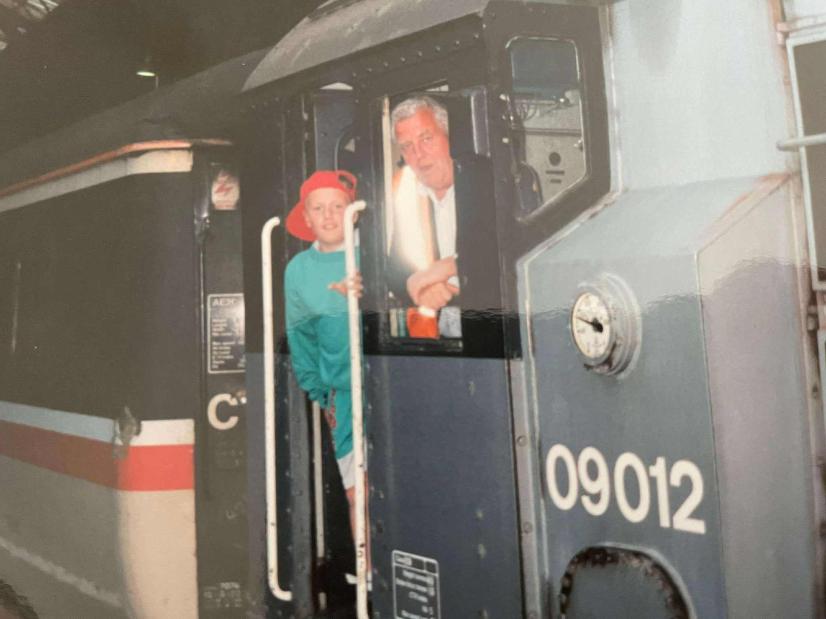
Brighton Driver Peter White
LOCOMOTIVE JOURNAL
MAY 2026
BRIGHTON PETER WHITE
DEDICATED UNION REP
My husband, Peter George White, was a dedicated and lifelong union member and union rep.
He started work in 1956, aged 14, in the British Rail offices at Wisbech in Cambridgeshire.
In May 1960 he moved to March depot as a cleaner and, after 18 months, was promoted to
fireman, working on the main line. In 1971 we moved to Gillingham in Kent where he started
work as a driver and was elected Gillingham branch secretary. In 1973 he joined Faversham
Constituency Labour Party, becoming a town councillor in 1979 and also a Kent county
councillor. He was a school governor for Davington primary school and Bysing Wood
primary school and the first Labour Party man to be appointed for 600 years to Faversham
Grammar School! Peter moved to Maidstone depot, and then in 1984 to Yorkshire; he
transferred to Knottingley and, later, Huddersfield and then in 1993 to Brighton
which is where he retired and was given a great send-off. There was a dinner/dance at a seafront hotel in Brighton, we had a room there overnight, and received flowers and many gifts.
Yvonne White
LOCOMOTIVE JOURNAL
MAY 2026
BRIGHTON DRIVER
MICK HAWKINS
It is with great sadness that I report the passing of our colleague Mick Hawkins from Brighton.
Mick was a dedicated ASLEF member and, since his retirement, has supported and attended all our RMS forums and AGMs. Mick was a gentle giant, caring, and very sociable; it was a pleasure to be in his company. It was an honour to have known him; he will be sadly missed by all those who knew him.
On behalf of the ASLEF RMS committee, we send our deepest condolences to his family at this sad time.
Bill Dale
RMS chair
A.S.L.E.F. PRESENTATIONS AT THE 2026 REUNION
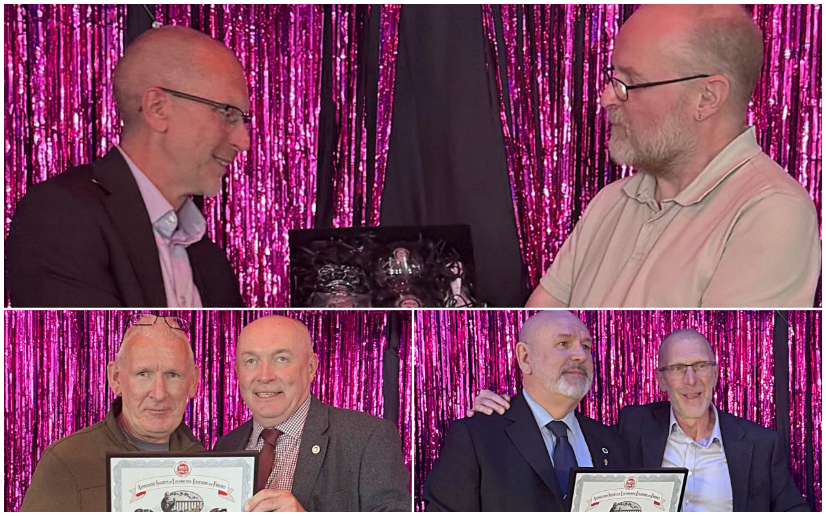
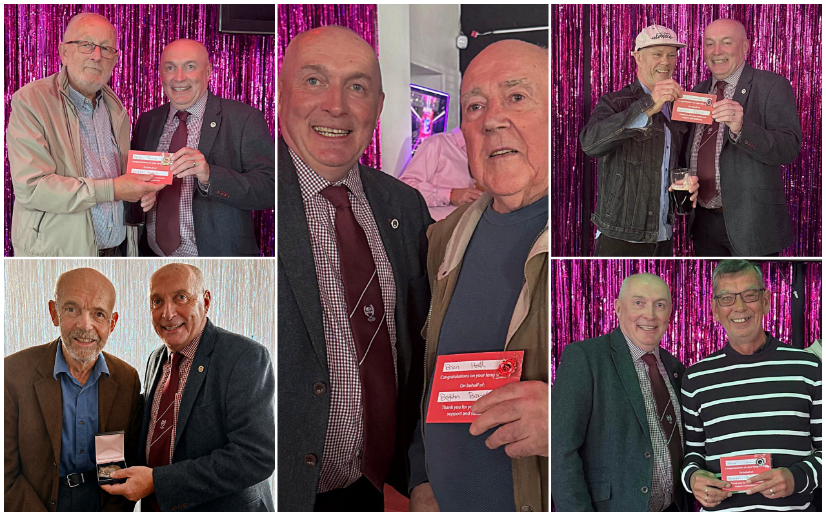
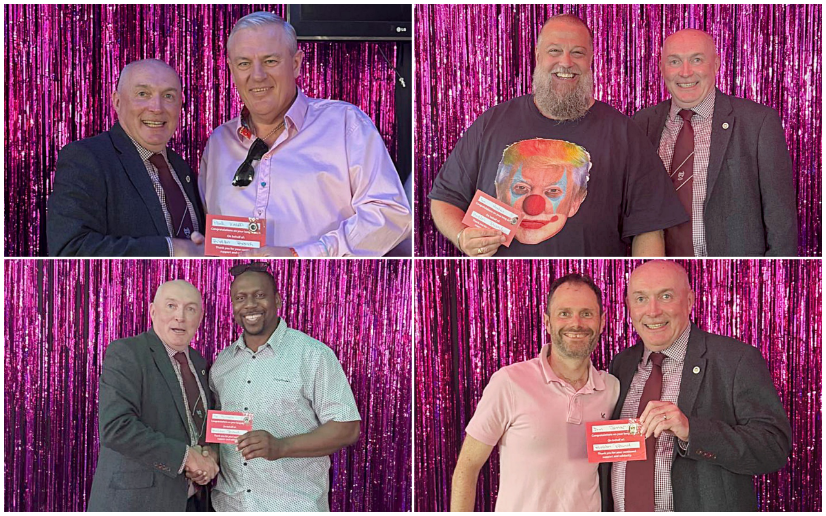
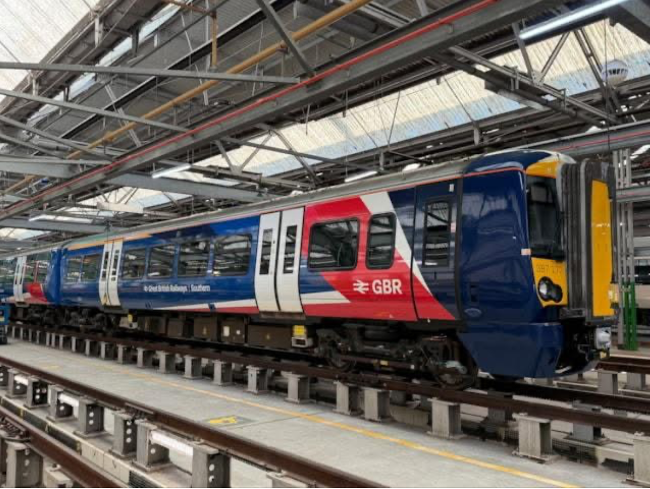
PHOTO COLLECTION UNKNOWN
The first Great British Railways branded, Class 387172 train was unveiled at a presentation in Brighton on the 21st May 2026.
The photo sees the train under wraps in Lover's Walk.
LOCOMOTIVE JOURNAL
JUNE 2026
Brighton Rocks
Brighton & Sussex ASLEF branches held its annual social gathering on Tuesday 5 May with members past and present travelling from all parts of the district, and some ex- members from all round the country, from Scotland to Cornwall and many points in between.
The branch had the pleasure of having GS Dave Calfe, outgoing GS Mick Whelan, AGS Simon Weller, DO1 Paul Donnelly, EC1 Marz Colombini, and DO5 Nigel Gibson in attendance.
A minute’s silence was observed for those who have risen to the top link; Dave thanked Simon for a comradely GS election campaign; and this was followed by the most important part of the afternoon, making presentations to members: Dan Jenner and Mo Sinera 10 years; Ian Hughes, 25; Paul Knapp, 35; Richard Hughes and Trevor Parsons, 40; Richard Lawrence, 50; Spike Jones, 60; and Brian Hall, 70.
Retirement certificates were presented to Steve Chatfield and Bob Kettle and a special
presentation was made to Steve from the branch.
Many thanks to Paul Edwards who organises the reunion each year and to Mark Johnson, who once again produced a badge, which was sold on the day. Proceeds go towards the cost of this long-running event, and was well-supported by those in attendance. If you’re interested in coming to next year’s social it will be on Tuesday 4 May, at the Brighton railway club.
Ian Buxton
Brighton 035
Branch Secretary
LOCOMOTIVE JOURNAL
JULY 2026
MICJ HAWKINS
ON THE SHOVEL OF THE BULLEIDS
It makes me very sad to have to report the passing of my dear friend and colleague, Mick
Hawkins. Mick retired a few years ago, due to ill-health, but remained a staunch member of
the Retired Members’ Section of our union.
Mick was firing at Brighton until he passed, went to Selhurst for his job and, on returning to
Brighton, on the mixed traction side of the depot, was soon elected to the LDC where he
stayed until he retired. He was our branch chair and health & safety rep for many years, probably one of our longest-serving union reps.
He was a top link fireman and, when we had steam specials in Brighton, he was the man on the shovel on the Bulleid engines.
Outside of work he was a gentle but fun-loving dad, husband, and friend. When you work with blokes for years you often hear them pass their opinions about others that they didn’t like or who didn’t come up to scratch in some way or another. But, in 66 years or so of friendship I can honestly say I never heard that from Mick. He accepted everyone for who they were, and treated them accordingly, and I think that is part of the reason he was so well-like and appreciated.
In retirement he stayed loyal to ASLEF and, as a member of the RMS, attended all the meetings and forums, the last being the AGM at Sheffield where he realised he was unwell. He was diagnosed with a cancer which eventually took him and robbed us of our dear friend and Susie of her dad. He will be deeply missed by all of us and the attendance at his funeral on Thursday 7 May shows how well-liked and loved he was. Have a well-earned rest, old friend, for the love and friendship you shared, you deserve it.
Spike Jones
RMS Brighton
LOCOMOTIVE JOURNAL
AUGUST 2026
TRAIN TRACKS ARE PURPLE
HOWARD CUNNELL ’s acclaimed memoir Fathers and Sons, which explores his experiences as a fatherless man raising a transgender son, was described by the Financial Times as ‘unique, and uniquely beautiful’ and was chosen as a Book of the Week on Radio 4. His new book Sun Country (Bloomsbury, £18.99) is a sort of sequel, written after the death of his mum Gillian, a devoted single mother, which takes a deep dive into his family history on the south coast of England. In these extracts he writes beautifully, thoughtfully, and movingly, about Eastbourne, the surrounding Sussex countryside, rural poverty, trains, and his great-grandfather Charles Lawrence, who was a train driver, a Methodist lay preacher, and a dedicated ASLEF union activist.
THE country we pass is made distorted, trembling, by falling lines of rain. Looking out the train window I conjure the 19th century Sussex landscape that W.H. Hudson loved, when the last of the long-horned oxen pulled the wain and the plough, and my people worked the land, reaping the corn with sickles in the ancient way, the air fizzing with insects, the smell of sweat and dried manure, and the vision of thistledown springing up from the grass in hundreds and thousands of ‘delicateaerial forms’, moving beyond visibility across ‘the immeasurable blue expanse of heaven’.
We’re coming out of Lewes. The rain has stopped, and thick fingers of sunlight are falling
on the escarpment of chalk I can see out the left-hand window of the train, making a
perfectly spaced, momentary colonnade, blushed pink and shining wet with rain. The light turns the River Ouse the colour of honeyed mud as it flows alongside the town.
The train tracks are purple. Rubbish fills the high embankments between the tracks and the
land. From the train window the tableland of Kingston Hill – where Hudson spent a memorable, ‘unenclosed’ hot day in August 1900, under the vast void of blue sky in the
burning sun and wind, a day and place that reminded him of the old days on the endless
Argentinian pampas – is a startling exception in a landscape of fields, pastures, paddocks, that
never seems flat, but swells, bulges, tilts.
Charles Lawrence was born on 4 May 1872 on the estate his father worked and lived on: Great Bines farm in Burwash, in East Sussex. The Lawrence men all worked as farm labourers.
The women were housewives or domestic servants, often both.
Between 1760 and 1830, villages throughout England like Burwash and Rotherfield began to
be enclosed by Parliament. Before the Act of Enclosure, an open field system operated. The
village was at the centre of a wheel of fields. Crops were rotated annually. Each village had its commons and waste grounds where local people could keep livestock – a pig, a few sheep
or some geese, cultivate arable land on strips in open fields and gather firewood. Romani would camp and trade.
Wages were lowest in the corn-growing south, where paid work was seasonal. After harvest time, men might be lucky enough to be put to work threshing or flint gathering in the fields for starvation wages, but most often there was no work. People were left to survive the best they could in the bitter winter. The right to raise food and gather fuel on common land
kept the labourers and their families from complete poverty and hunger. Smuggling and
poaching were acts of resistance and survival for men desperate to feed their families.
Enclosure meant that fields were fenced. Trees were cut down, and the course of streams and
rivers were changed to keep the new lines of fields and ditches straight. Gates and No Trespassing signs appeared. The unfenced, open, circular landscape becomes closed, fenced-in and private, patrolled by armed gamekeepers.
Between 1750 and 1850 enclosure turned over six million acres of meadows and open fields into private fields. Final enclosure will list the ownership of every acre, every field, every
road and footway. The freedom to roam through the known world is lost forever.
Common land, free land, disappears. ‘Enclosure like a Bonaparte let not a thing remain,’ wrote the labourer, naturalist, and poet John Clare. ‘It levelled every bush and tree and levelled every hill | And hung the moles for traitors – though the brook is running still, It
runs a naked brook, cold and chill.’ Soldiers returning from the Napoleonic Wars after 1815, many of them physically and mentally wounded, came back to rising food prices, poor harvests, low wages, high unemployment and the new technology of the threshing machine. Threshing – separating the grain from the stalks by beating it – gave men what was often their only employment in the winter months. Now workers were no longer needed to perform this ancient task. The threshing machine became a hated symbol.
The Poor Law offered a bare minimum income for the unemployed – an amount of money just sufficient to keep families from starving – but this only encouraged employers to hire men for the lowest wages possible, relying on the parish to support the unemployed. Between enclosure, the Poor Law, and the post-Napoleonic war economy, the English labourer was dispossessed and starved.
The administration of poor relief became harsher and more humiliating. In Sussex there were reports of people being hitched to carts and made to wear bells around their necks, of mock slave auctions. What had been taken away was everything that makes life more than just a
struggle to survive.
1830. The last great uprising of English agricultural workers. Protests started in Kent and Sussex and spread throughout the south. Labourers demanded secure jobs and wages they could live on. Rectors were told to lower tithes or face the consequences. There were wage and food riots and the destruction of threshing machines. This is the time of Captain Swing, of the anonymous letter – destroy your threshing machines or your barns, corn ricks and house will be burned down. Fires blazed all over Sussex – a huge fire near Worthing could be seen for miles around.
Between 1 January 1830 and 3 September 1832, there were 145 disturbances in Sussex, including 67 wage and tithe riots and 34 cases of arson. Black flags and tricolours were reported in Rye. In Charles’s home village of Burwash, local overseers were expelled from the parish.
Then came brutal repression. Force was used to crush anyone who resisted. In East Sussex,
troops of the 5th Dragoons were sent to many villages, including Rotherfield. The Duke of
Wellington ordered magistrates to ‘put themselves on horseback, each at the head of his own servants and retainers, grooms, huntsmen, gamekeepers, armed with horsewhips, pistols, fowling pieces and what they could get’, and ‘to attack these mobs’. From horseback, the gentry hunted men through the fields like game. Destroy them, the hero of Waterloo said. Take and put in confinement those who cannot escape. Nearly 2,000 cases were heard. 250 men were sentenced to death. Nineteen were executed. Seventeen men from Sussex were transported, out of a total of 481 men sent to Tasmania or New South Wales.
When Charles and Catherine were young, stories about the uprisings of 1830 would have been foundational narratives, recent history that explained their world. The stories handed down – of dispossession and hunger, resistance, torchlit mass meetings, the intoxication of action, the power of the many, machine- wrecking, the night skies lit by fires, stories of
defeat, terror, being hunted down, imprisonment and transportation – were part of their psychological landscape, like the fenced enclosed fields, and the great iron and timber train tracks spreading like black veins through the green world. For people like Charles and
Catherine, stories, children, and gravestones were all that they left behind. Stories and lessons of loss, of the transformation and destruction of a world.
CHARLES and Catherine marry in March 1899. They may have lived first in Crowborough, near Ashdown Forest, 15 miles from Burwash, but soon they are living in Eastbourne, where Charles works as a steam locomotive fireman, on his way to being an engine driver.
The coming of the railway in 1868 and the planned development of the town by the principal landowners meant that by the end of the 19th century Eastbourne had become a boom town. An attractive destination for an ambitious working- class couple. The special project to turn Eastbourne into a new, upmarket seaside resort is well underway. A grand new railway station, built by the London, Brighton & South Coast Railway company, opens in 1886, from which a planned road – Terminus Road – leads tourists straight down to the promenade and the sea.
I have a vision of a boy watching from some secret point of elevation in the Weald dark
machines moving through the Sussex countryside, new dreams of his future forming like the shifting clouds of steam he can see more clearly than he can the trains themselves. I’m sure I remember being taken to watch the last steam train leave Eastbourne, standing on a bridge, a classic viaduct in my mind, where Nan, Mum, my brother, me, disappeared into a great exhalation of steam as the train thundered beneath us, a half-memory that is really just an image of disappearance and reappearance.
I remember Nan, neat and trim, taking my brother and me to London, the three of us sitting in a first class carriage that wasn’t first class, but open to anyone who knew about it – there was one of these carriages at each end of the Eastbourne-London-Eastbourne trains for years, until these kinds of trains, with slam doors, smoking carriages, windows you could open, luggage racks, a buffet car, were discontinued, so that when I started going up to London in the 1970s to see the Arsenal when I was still only 12 or 13, me and the older blokes I went with would always take over the pretend first class carriage, and lord it up with our tins of beer.
When Émile Zola was researching the working life of a train driver for his novel La Bête Humaine in 1869, he took a trip on board a locomotive, standing on the footplate with the driver and the fireman. Zola describes his train driver Jacques Lantier, ‘warmly dressed in
woollen overall and trousers, with his cloth- sided goggles tied at the back beneath his cap’.
Lantier’s gaze is fixed on the track ahead, and he repeatedly leans out to see it better, his hand on the gear wheel, continually slackening or increasing the speed, and pulling on the whistle
with his free hand. When Lantier opens the firebox door, his fireman breaks up some coal
with a hammer and spreads it with his shovel in an even layer over the grate. ‘A searing wind
burned their legs; then, with the door shut, the icy cold wind blew once more.’ I’m grateful to
Zola. I don’t know a 19th century English novel that will tell me what driving a steam train was like.
Charles Lawrence may have already been a Methodist before he came to Eastbourne in his late twenties. Possibly he and Catherine met at a Methodist prayer group or open-air camp
meeting. Maybe one of his co-workers on the railway invited him to a meeting, but it’s just as
likely Charles was brought up in the traditions of 18th- and 19th-century Protestant dissent. His life shows him to be a lifelong opponent of established political, social and religious order. Under John Wesley’s leadership, Methodism was a non-conformist Protestant revival movement, strong in working-class communities, especially where labour was organised.
Methodist societies were organised into small groups of 12 or so. Each member had a duty to contribute a penny a week to help the poor. Methodists campaigned against slavery, enclosure, harsh work conditions, drunkenness, prostitution, and the lack of education for the
poor. They were also against alcohol, gambling, dancing, the theatre, sport, reading novels or
the Sunday newspapers.
Methodism was, E.P. Thompson writes in The Making of the English Working Class, ‘a religion which found a place for humble men, as local preachers and class leaders, which taught them to read and gave them self-respect and experience in speaking and in organisation’. At the same time, Methodism ‘condemned working people to a kind of moral civil war – between the chapel and the pub, the wicked and the redeemed, the lost and the saved’.
St Aidan’s Primitive Methodist chapel in Whitley Road, which opened in 1913 (and was
closed and demolished in 2001) was a three- minute walk from Charles’s home in Neville
Road. Primitive Methodism was believed by its supporters – like Charles Lawrence – to be a
purer form of Methodism. It was evangelistic, activist and egalitarian, embracing hard work,
personal responsibility, thrift and abstention from worldly pleasures. It was known as the
most working-class of Methodist bodies and was closely associated – as were all Methodist
groups – with rural trade unionism in the 1830s, and with the labour movement and the
formation of the Labour Party in 1900. Here, Charles – a worker, a neighbour, a friend – taught Sunday School for over thirty years. Sunday School would not just have been Bible stories for children, but Bible study and literacy classes for adults, as well as a place for people to talk among themselves about their grievances and struggles, to organise, to fundraise for good and practical causes.
A railwayman, trade unionist, and a radical Protestant whose socialism was built on the
religious principle of loving kindness, Charles Lawrence is at the centre of multiple and
interconnected networks of tough, organised and aspirational working-class people. In 1922,
he was elected as a Labour representative for the Roselands ward to the town council. He later stood as the losing candidate in 1925 and 1926.
FOR many years Charles Lawrence was secretary of the district council of the Associated Society of Locomotive Engineers & Firemen. The records of the Eastbourne branch of ASLEF (founded on 25 February 1906), report a smoking concert on 23 October 1937 (Eastbourne Branch Report Locomotive Journal February 1938). A smoker was an informal live concert for a men-only audience (women were not supposed to smoke in public), most often held to mark a significant occasion. There was drinking as well as the singing of possibly bawdy or blue songs.
Many ASLEF union members – including several from the nearby towns of Ore and St Leonard’s, several National Union of Railwaymen members and a representative from the Eastbourne Trades Council and local Labour Party – ‘braved the elements to give a send-off to Brother Charles Lawrence, who has retired from the railway company’. Musical items
were rendered by Brother Beeney and ‘Ginger’ of St Leonard’s branch and other local stars, with Bill Painter of Brighton at the piano (I don’t think Charles would like any off-colour songs, and he wouldn’t have been a drinker or smoker, I’m certain of that. Was he pious and, if so, was he teased about it? All I know about him is what surfaces in the public record, where his rectitude conceals any possible playfulness or light heart. Also lost are his imperfections, prejudices if he had them, black moods, despair).
The smoker was probably held at the Eastbourne & District Trades Council, 112-114 South Street, the headquarters of the Eastbourne Labour Party and the ASLEF branch, where there were rooms for rent as well as rooms for reading, billiards, cards, and concerts South Street is close to the train station, and the building stayed open until 10.30pm.
Brother Sweeney gave a speech, praising the record of Brother Lawrence’s services to ASLEF and the working-class movement in general, and for such spirit to be carried on by the present generation in order to safeguard the future. Brother Lawrence ‘suitably replied, and stated that although he had finished as far as the railway was concerned, his interest in the
movement was still as great’. Brother Sweeney then presented Brother Lawrence with a
Westminster chiming clock as an appreciation for the service he had given to his fellow workers.
Excepting the Bible, I don’t know if Charles was a reader (I think he must have been, though what time did he have for reading, between driving trains, teaching Sunday School,
preaching, political work and fundraising, and his family, but there was a local branch of the
Left Book Club at the Saffrons, not far from the train station), or what he read. George Meek, a socialist organiser in Eastbourne in the early 20th century – who would have known Charles
Lawrence, and who for 20 years earned a precarious living pulling a Bath chair (a kind of
rickshaw) along the seafront parades – wrote an autobiography that was published in 1910 with an introduction by H.G. Wells.
Meek writes about bad luck, trouble, imprisonment in Lewes prison, poverty and life
in unfurnished, pestilential rooms in houses built on what was marshland east of the pier
(‘Eastbourne is one of the loveliest pleasure towns in England,’ he writes. ‘It is the paradise of the idle and sometimes vicious rich… but it is a hell to the poor who try to live in it by casual labour’). The book is also an account of Meek’s fervent, unsystematic reading. Meek reads Homer, Milton’s Paradise Lost, Thomas Hardy and Oliver Goldsmith. Émile Zola, he writes, is ‘the greatest writer of modern times’.
The imagined bookshelves in Charles Lawrence’s house on Neville Road hold John Wesley’s Articles of Religion (1784), his statement of Methodist doctrine, William Cobbett’s Rural
Rides (1830) – for Cobbett’s advocacy for the labouring poor and his association with the
1830 uprising – Bunyan’s The Pilgrim’s Progress (1678), The Kingdom of Christ (1842) by FD Maurice, founder and principal of the Working Men’s College, Charles Kingsley and John
Ludlow’s Politics for the People (1848), a complete run of the Christian Socialist journal edited by the two men.
Maybe Samuel Bamford’s Passages in the Life of a Radical (1844), his eye-witness account of the Peterloo Massacre, and the trials and imprisonment of the leaders of the working-
class movement that followed, published the same year as Engels’s The Condition of the
Working-Class in England (1845). Perhaps some Methodist conversion narratives, popular in the movement, in which troubled youth find salvation. The ASLEF Locomotive Journal.
Charles Lawrence's seniority was the 9th September 1892
LOCOMOTIVE JOURNAL
OCTOBER 2026
TRAIN TRACKS ARE PURPLE
Simon Weller has been elected president of the TUC for the next 12 months. Simon, who was also re-elected to the general council of the TUC, and executive committee, is only the third train driver, and ASLEF member, to be TUC president in 158 years. John Bromley, General Secretary from 1914 to 1936, and Labour MP for Barrow-in-Furness from 1924 to 1931, was president of the TUC from 1932-33, and Ray Buckton, General Secretary from 1970 to 1987,
was president in 1984-85.
Like those years, these are momentous times,’ Simon told congress, ‘with the world plunging into irrevocable change, with the rise of the far right, and the collapse of seemingly safe jobs. I was privilege to start with British Rail in the 1980s in a job that gave me a full career from a young age. A career that allowed me to buy a house, bring up a family, and provide security for them'.
Simon joined the railway, as a driver's assistant, in 1987, as a teenager, and immediately joined ASLEF. He passed as driver in 1989, working out of Waterloo, Aberystwyth,
Warrington, Westbury, and Brighton. Simon was elected branch chair at 19 and went on to serve as a local level rep, company council rep, and executive committee member for District 1. In 2009, after 20 years of driving trains, he was elected assistant general secretary, and joined the T.U.C.'s general council in 2011.
'My focus will be ensuring other young people can follow in this footsteps.
Apprenticeships have their place, but we are seeing a shortage of decent jobs and decent careers for young people – and that must change.
‘I look forward to working with all TUC affiliates over the next year to deliver on our mission to create a fairer, more prosperous, and more equal Britain for everyone.'