TIDE MILLS AIR ATTACK
JULY 3rd 1940
These reports features
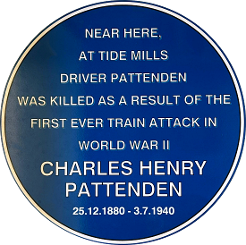
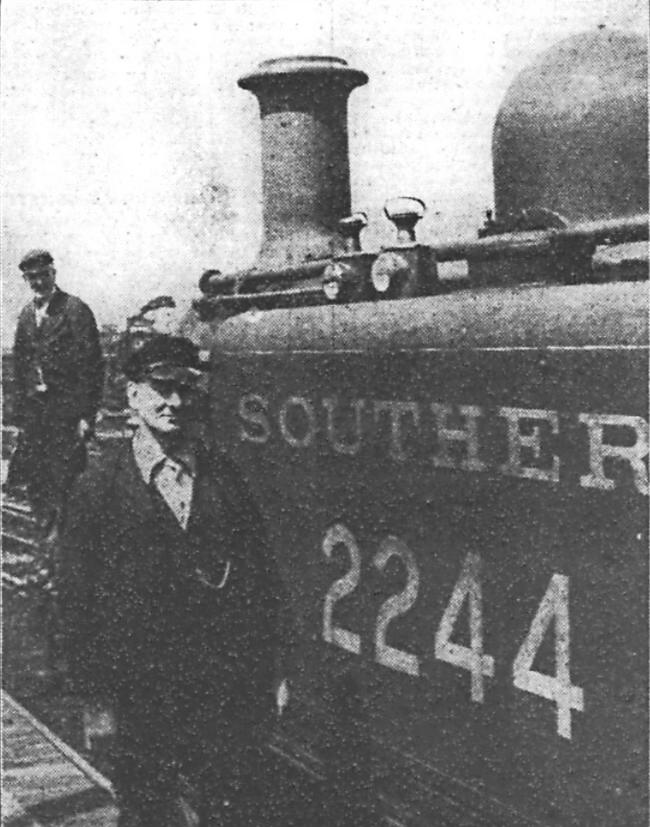
Driver Charles Pattenden and his Fireman FrankCox
Driver C. Pattenden of Tunbridge Wells Branch was killed when his train was bombed and machine gunned by a German plane: he was the first of many which went to prove the "lines behind the lines" were not so very far in the rear.
Taken from
“The Lighted Flame”
Then, the Second World War was just 10 months old. For most of that time very little fighting had happened between Britain and Germany, in particular by Britain against Germany, the period thus being called ‘The Phoney War’. There were sporadic attacks on shipping, an early one being the Luftwaffe’s first attack off the coast of Sussex, when the Luftwaffe attacked and sank the SS Barn Hill off Eastbourne on 22nd March 1940.
Equally there was nothing phoney about Hitler’s attack on France. The Battle of France occurred over the six-week period 10th May to 25th June 1940. German forces defeated a very strong adversary which had the benefit of the Maginot line, some excellent equipment especially high-quality tanks, the ‘home advantage’ and reinforcement by significant Dutch and Belgian forces, plus of course the 12 infantry divisions (390,000 men) and RAF fighter aircraft of the British Expeditionary Force (BEF). As we all know the soldiers of the BEF fought well but were then encircled and then evacuated, with French and Belgian allies, from Dunkirk, in Operation DYNAMO 26th May – 4th June. France was forced to sign a surrender on 22nd June 1940. The Germans occupied the whole of the north of France and established airfields and army garrisons throughout.
On the 1st / 2nd July the RAF attacked the warships in Kiel naval port and the next day 2nd / 3rd July, some 16 RAF bombers attacked German railway facilities in Hamm. This set the German mood for a campaign of air attacks against Britain, both in the Channel and on land targets.
Air Chief Marshal Sir Hugh Dowding, Air Officer Commanding of RAF Fighter Command, considered the Battle of Britain to be from 10th July after escalation of German attacks on British shipping, and greater engagement between the RAF and the Luftwaffe. However a broader interpretation would include the preliminary small-scale attacks before 10th July as being part of the Battle of Britain. Churchill himself considered the Battle of Britain to have started very soon after the fall of France. He had coined the term ‘Battle of Britain’ in a speech to Parliament on 18th June.
However defined, the Battle of Britain, prelude to a German invasion, was imminent or underway in June and early July.
These small scale attacks were termed a ‘tip and run’ or a ‘hit and run’ by civilians. Thereafter the threat of invasion was very real for everyone in Britain. These nuisance raids were used to train bomber crews in both day and night attacks, to test British defences and to try out attack methods.
‘The war against England is to be restricted to destructive attacks against industry and air force targets which have weak defensive forces. The most thorough study of the target concerned, that is vital points of the target, is a pre-requisite for success. It is also stressed that every effort should be made to avoid unnecessary loss of life against the civilian population.
The morning of 3rd July 1940, was the first recorded attack on Newhaven, which may well have been the first air attack on a land target in Sussex in World War II, was conducted by a single aircraft, almost certainly a Dornier D-17K from its airbase in occupied France, near Reims (or Rheims). The medium bomber approached the town from the South West at 9.20am. It first strafed soldiers who were spread out along the beach but who had already dived for cover on hearing the engine noise in the sky. The aircraft then headed to town and continued firing its machine guns. People had already taken to the shelters or taken cover as the air raid sirens had sounded as the aircraft was approaching the coast. Machine Gun fire caused minor damage to roof tiles and broke some windows, but there were no casualties. The aircraft left the town environs but soon returned flying in lower and again strafed the town with machine gun fire. Local anti-aircraft (ack-ack) guns, possibly at Newhaven Fort, opened up and the aircraft then dropped its six bombs which landed in the sea, just outside the harbour. It is possible the aircraft was intending to bomb the two-masted HMS Schievan (an ex-steam ship that checked passing vessels at the harbour approaches) but the ship was undamaged.
At 5.30 pm on that same pleasant summer’s day, Seaford’s air raid sirens sounded. The citizens took shelter prepared for their first air raid of the war. Ground defences spotted a single incoming aircraft and opened fire ferociously. The bomber pilot took fright and jettisoned four High Explosive bombs in the sea, 75 yards from the shoreline and near the middle of Seaford Bay. The aircraft turned tail and headed back to its base in occupied France.
At this time Driver Pattenden, would be preparing his cab on the leading coach of the push pull set, whilst his Fireman Cox would left on the footplate of the engine, and attending to the engine's fire, whilst awaiting departure. Brighton Guard, Edward Batchelor, would have been briefly conversing with passengers as they boarded the train. (Later, newspaper reports refer to there being just a small number of passengers. Known passengers were: Mrs May Terrill of Lawes Avenue, Newhaven and her two children, a daughter Celia who was four years old, and a son, Ronald, who was one year old; Mrs P Steward of Brighton Road, Newhaven and her friend; and Mrs Matthews of Paddock Road, Lewes). It appears that many other citizens had heeded the wartime mantra not to travel unless their journey was ‘really necessary’.
Amongst the background of air raid sirens, explosions and machine gun, the 5.37 pm the train departed from Seaford Station, and made its way to Horsted Keynes. Its first stopped was Bishopstone Station, and the train departed on time making its way to Newhaven.
As the train was passing through the Tide Mills area. This stretch of the line is very exposed and is about half way between Bishopstone and Newhaven Harbour stations. A single German Dornier bomber was seen fast approaching the coast from France. The lone enemy aircraft unmercifully opened fire on it with machine guns. The passengers took cover by crouching on the carriage floor. Bullets easily penetrated the train’s carriages. With the passengers taking cover, by crouching on the carriage floor. Bullets easily penetrated the train’s wooden carriages.
There is no record of the aircraft being engaged by the RAF or anti-aircraft gunners on the ground. Many tip and run attacks were very short in duration, some being only 10-20 seconds long and such reaction was difficult.
The aircraft then delivered its load of six bombs, probably of the 50kg type, which exploded in the nearby Oyster Ponds, which were not far from Tide Mills. The train had by this time come to an abrupt halt. Although neither train nor carriages were directly hit by the bombs, they felt the force and suffered blast damage, with most if not all of the glass being shattered. Splinters struck the driver, Charles Pattenden causing a severe injury, and he died a short time later. The guard, Edward Batchelor, received a serious back injury from flying shrapnel. The Fireman, Frank Cox, was uninjured.
Mrs P Steward, and her friend, had seen the plane swoop down and thought she heard just two explosions. The force of the attack blew the toe off Mrs Steward’s right shoe. The windows were smashed and the carriage filled with flying glass.
*Mrs May Terrill said to a reporter a short while later: “It happened so quickly. All the windows were smashed and we had lots of splinters of glass in our hair. My son, **Ronald, had a cut near one eye and the back of my coat was marked, as if it had been scorched”.
The train was brought stopped in the Tide Mills area, for 12-and-a-half minutes. Fireman Cox went to check the condition of Pattenden, and certainly rendered assistance to the wounded, but to no avail. Even though the guard, Edward Batchelor, had received serious back injuries, he too went to give assistance to the passengers and to the driver.
Fireman Cox resumed the journey, by driving the train into Newhaven Harbour Station, arriving 12 1/2 minutes late. Meanwhile the railway staff at Newhaven Harbour station had raised the alarm and call for ambulances, and other assistance to attend at the station.
Either the ambulance staff or the volunteer First Aiders determined that Mr Pattenden was deceased and one account says that he was taken away from the scene in the ambulance. A more credible account is from Newhaven Loco fireman Dave Boyle who said that he saw Mr Pattenden’s body being placed in the back of a lorry, presumably a small lorry, was covered and then driven away. His place of death was later recorded as being Newhaven Harbour Station. He was certainly the first civilian killed in air raids in the Newhaven, Seaford and Peacehaven areas, (as recorded in the book ‘Coastal Blitz’). However, Driver Pattenden was to become the first railway worker to be killed by enemy action on home soil.
The guard, Batchelor was initially taken to a First Aid post in Newhaven and was treated for his shrapnel injury by a volunteer in her 70s, Alice Simpson, who hailed from Bishopstone, who recorded the fact in her wartime diary; she made no mention of treating any of the passengers although a post-attack document produced by Southern Railway stated that four passengers had been injured.
The Southern Railway some time later sent a telegram to Charles’ widow, Jane, informing her with regret, of the death of her husband.
Both Frank Cox and Edward Batchelor, had gone above and beyond their duties to render assistance and their actions whilst under attack from enemy aircraft. This was to become recognised by the Southern Railway in the following weeks.
* Mrs. May Terrill's husband, Bill, was engineman at Newhaven Loco. Shed (23.01.1920).
** Ronald Terrill, later became a engineman at Newhaven Loco. Shed (13.09.1954).

The funeral of Charles Pattenden was held at The Borough Cemetery on a Saturday morning and reported in the 12th July issue of the Kent and Sussex Courier.
The funeral was well attended by many Tunbridge Wells enginemen and members of the Tunbridge Wells Branch of A.S.L.E.&F., whom Charles Pattenden and Frank Cox were members of. The was also several other railway workers. The pallbearers included his fireman Frank Cox, along with fellow engine-men from Tunbridge Wells, Messrs. J. Enfield. T. (F.?) Robinson, W. Wickens, C. Goreham, and F. Elmer. Both Charles Pattenden and Frank Co, were members of the Tunbridge Wells Branch of A.S.L.E.&F.
At Waterloo Station on Friday 18th August 1940, eighteen members of the Southern Railway staff received the first batch of a new decoration to be known as the Southern Railway Meritorious War Service Medals awarded by the company. The medal, designed and modelled by Mr. George Kruger Gray, is of silver gilt (gold being unobtainable during the war), and the medal represents a driving wheel combined with a laurel wreath and an early from of the Victoria Cross.
These medals were presented by Mr. R. Holland-Martin, chairman of the Southern Railway. Among the among the recipients were Tunbridge Wells Fireman Frank S. Cox, and Brighton Guard Edward Henry Batchelor. Their train was bombed and machine gunned by a German plane while travelling between Seaford and Newhaven, the Tunbridge Wells driver Pattenden, being fatally wounded. Guard Batchelor, though injured by shrapnel, "acted with commendable promptitude," and Fireman Cox, after rendering assistance to the injured, drove the train into Newhaven
ENGINE DRIVER CHARLES HENRY PATTENDEN
1880 - 1940
Known Footplate Career
Started at Tunbridge Wells as an engine cleaner, week ending 9th June 1891, aged 17. (date according to Railway Records). (N.U.R. Southern Railway Seniority Book of 1925, states he started on the footplate on the 1st June, 1898).
Week ending 10th July, 1903, aged 22, promoted from engine cleaner to Fireman at Tunbridge Wells.
Week ending 18th June, 1914, promoted from fireman to driver, aged 33.
Week ending 13th January, 1916, was one of many junior enginemen being "Put Back" to fireman aged 36.
Week ending 20th December 1917, promoted to driver, aged 37.
Week ending 19th May, 1926 moved from Driver to shed engineman, aged 45.
Week ending 18th August 1926 moved back to driver.
* Charles Henry Pattenden's father was also a engine driver, and shared the same name
---------
PASSED FIREMAN FRANK S. COX,
1895 - 1960
Known Footplate Career
Frank S. Cox, started at Exmouth Junction (L.S.W.R.) as an engine cleaner, on the 25th May 1917.
He transferred from Exmouth Junction to Tunbridge Wells West as a Fireman.Week ending 20th January 1932.
He passed for driving at Tunbridge Wells on the 13th June 1939.
Awarded with the Southern Railway (the first of) Meritorious War Service Medal on the 18th August 1940.
--------------
DESCENDANTS OF CHARLES HENRY PATTENDEN
Driver Charles Pattenden, born on the 25th December 1880, he had attended St. George’s school in Tunbridge Wells, had married Jane Thompsett on 13th May 1905 and lived in a railway-provided house. Together they had three sons and a daughter. One son was also called Charles Henry Pattenden and was Assistant School Attendance Officer at Tunbridge Wells, another son was also in the railway service and the third son was in the Fleet Air Arm.
----------
DESCENDANTS OF EDWARD HENRY BATCHELOR
1893 - 1946
Brighton Guard was Edward Henry Batchelor from Brighton.
He had been born on 22nd May 1893 in Brighton.
He married Bertha Shoesmith and they had a son, Edward Charles Batchelor, born 26th June 1922 in Brighton.
Edward Charles Batchelor married Kathleen Bilton, and they had 2 sons,
Edward Brian (Bryan) Batchelor born in 15.07.1947, married someone by the surname of Erriker. Died at Harlington, Bedfordshire in 2005.
(Edward) Brian Batchelor started on the footplate at Brighton on the 01.01.1963
Graham John Batchelor born in 1949. Graham John Batchelor married Susan Peters in Brighton, and they had Emma Jane in 1974 and Anne Marie in 1976. . Graham Batchelor died in 2022.
On Wednesday 3rd July, 1940 the 17.37 train from Seaford was machine - gunned between
Bishopstone to Tide Mills. The driver, Charles Pattenden was killed but the passengers ducked down and tried to under their seats. The aircraft then dropped six bombs nearby which shattered the windows of the carriages and injured several passengers. Mrs May Terrrill of Newhaven who said afterwards, “It happened so quickly. All the windows were smashed and had lots of splinters of in our hair. My son Ronald a babe in arms had a cut neat one eye and the back of my coat was marked as if it had been scorched."
Driver Pattenden leaves a widow, three sons and one daughter, to whom the greatest sympathy will be extended. One son is Mr. C.H. Pattenden Assistant School Attendance Officer at Tunbridge Wells, another is also in the railway service and the other is with the Fleet Air Arm.
Bombs were dropped in other parts of South East England. At one place the German had a game of hide and seek with the aid of the low lying clouds. An eye witness said the enemy plane dived out of the cloud machine gunning the road and the fields, at the same time dropping a salvo of bombs. He repeated the performance three or four times, but all the bombs either fell in the fields or in woods.
Windows in a neighbouring vilinge were shattered by the explosions. At another place it is stated that a bomb fell through the roof of a house and landed on a settee without exploding.
Later in the day townspeople in another South East town saw three Spitfires give chase to a German Dornier. Bursts of machine gun fire were heard in the running fight, and it is stated that the German was brought down
THE LINES BEHIND THE LINES
MEDALS FOR RAILWAY STAFF
THE public has learned a lot recently about " the lines behind the lines" which have enabled us to maintain our essential supplies. Now we are to learn something of the patience, endurance, courage, and even heroism of the men who in the face of great danger have operated those "lines." But just carrying on" they have not only supplied our domestic needs, but have helped to transport a great Army to France and,
even more magnificently, to bring it safely home again.
OLD JUDDIAN REWARDED
Last Friday Mr. R. Holland-Martin, chairman of the Southern Railway, presented the first batch of a new decoration to be known as the Southern Railway Meritorious Service Medal.
Eighteen men in all branches of the Company's service in this country, in France, and on the Channel, who have shown initiative and devotion to duty in circumstances of hardship and danger, received the decoration. The medal, designed and modelled by Mr. George Kruger Gray, is of silver gilt— gold being unobtainable to-day-and takes the form of a driving wheel with a laurel wreath superimposed on the spokes. The recipients were;—
A. M. Newbold, general agent of the British Railway, Paris; R. G. Gangloff, agent, Calais;
M. C. A. Rieei, acting agent, Boulogne; H. H. Golding, captain; F. J. Hemphrey, elerk; G. Hunter, berthing master; F. A. Foad and E. A Roote, dock gatemen; W. Harris and J. H. Winter, porters; Gr. Mace, able seaman; T. Haslett, chief inspector; G. Pimes, fireman; T. Cooper, head shunter; G. Oak, erane driver; A. Holmes, wood machinist; F. S. Cox, fireman; and E. H. Batchelor, guard.
It is noteworthy that Mr. Arthur M. Newbold, formerly resident at Tonbridge, and like his brother, Capt. W. E. Newbold, who recently received the M.B.E. at Buckingham Palace, were pupils at the Judd School.
SOUTHERN RAILWAY MEDAL AWARDS TO LOCAL MEN
Two local men were among the 18 employees of the Southern Railway Co. to be presented with with the Company's Meritorious Service Medal on Friday. They were Mr. Frank Cox, of Tunbridge Wells, and Mr. E. H. Batchelor. Mr. Cox was the fireman of the passenger train which was bombed and machine gunned by a German raider down on the South Coast, when the driver, Mr. C. H. Pattenden, of Eridge-road, Tunbridge Wells, was fatally injured.
Mr. Batchelor was the guard of the train.
Also on the train were two women, Mrs Terrell of Lawes Avenue, Newhaven, and Mrs Matthews of Paddock Road, Lewes, and Mrs Terrell's two children, a daughter of four and a son, Ronald, who was one year old. Mrs Terrell said: 'It happened so quickly. All the windows were smashed and we had lots of splinters of glass in our hair. My son had a cut near one eye and the back of my coat was marked, as if it had been scorched.'