HAMPDEN PARK3rd JANUARY 1964
EXTRACTED & ADAPTED FROM BLOOD & CUSTARD WEBSITE
On the 3rd January, 1964, the 9.40 a.m. Ore to Brighton service derailed when departing Hampden Park derailed on the crossover at 10.18 a.m.
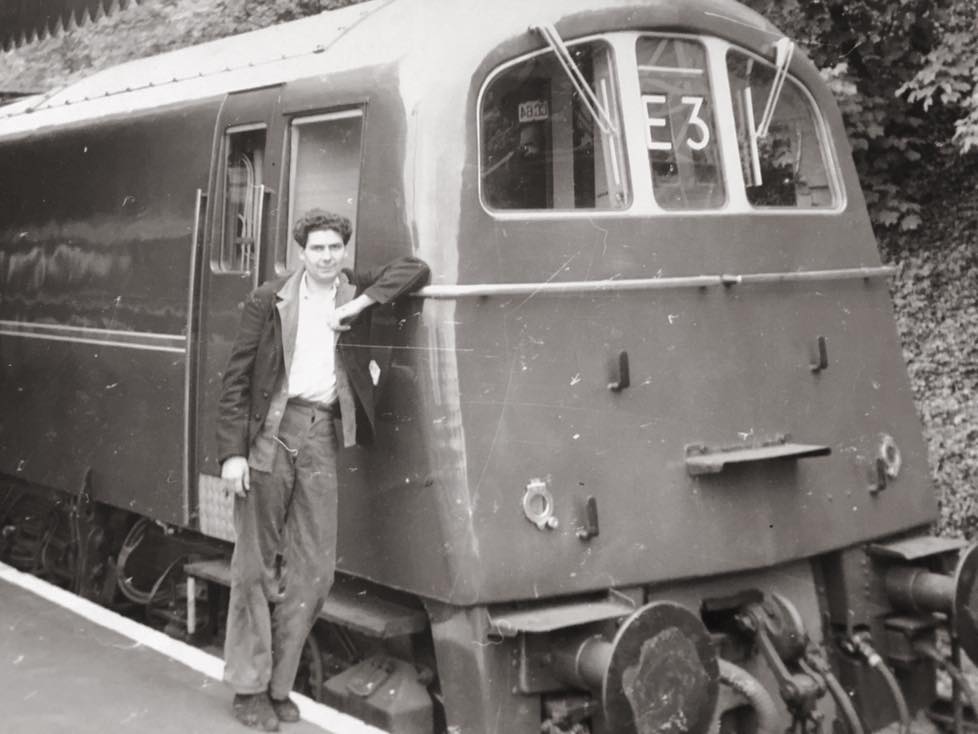
Horsham Loco Driver Rodney Burstow (15.10.1945) at Preston Park waiting to go light to Three Bridges, a gap just after leaving the loop, controller wide open second man pushed back in seat, wondered what was happening when juice regained!
Horsham steam depot was closed on the 27th January 1964 and became a Mixed Traction depot.
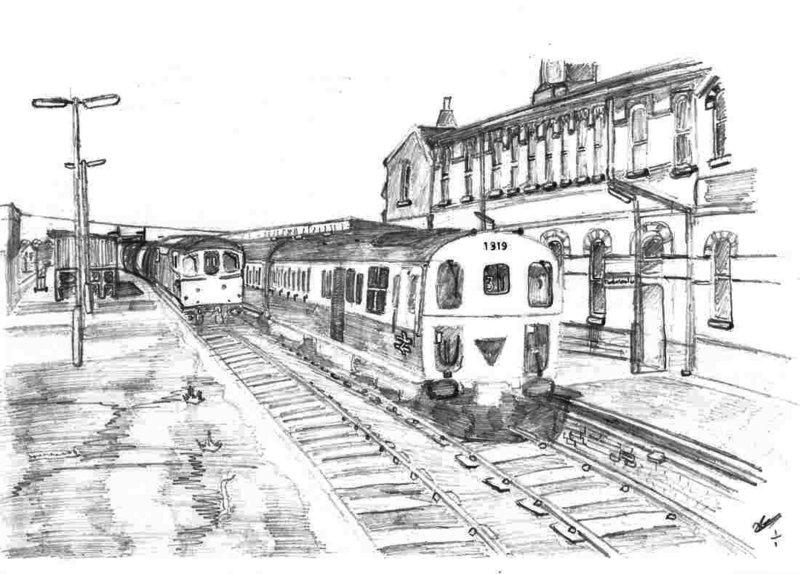
LOCOMOTIVE JOURNAL
FEBRUARY 1964
PORTSMOUTH (1) BRANCH
Portsmouth (1) wishes to extend best wishes to all readers for 1964.
The well attended December branch meeting resolved that in the event of the E.C. not recognising the anomaly regarding “Driver not entitled to an 8b move,” then a member of the E.C. be requested to attend this branch, and explain to the drivers affected why they are left in this most frustrating position.
Among the new Branch officers elected for 1964 was Bro. Ron Chick (vice chairman), and we hope that he will enjoy this very interesting position. Bro. Den Beard was elected to the vacancy on the L.D.C., and coupled with Bros. Jack Burghard and Ron Habershon we feel that we have a strong team.
In these items of modernisation and branch line closures, cutting down of services, etc., resulting in staff changes and roster alterations, it is essential for members to attend branch meetings and so keep in touch with the position. Why leave the decisions to a few? We regulars don’t want to be dictators. Let’s have some criticism (constructive, please!) in the branch room, and not in the messroom.
A. WallerBranch Reporter
LOCOMOTIVE JOURNAL
FEBRUARY 1964
THREE BRIDGES
PAGE 38
For the last meeting of 1963 there was a good attendance.
In the election of officers, Bro. J. Sayers stood down from the Committee, on which he had been for many years; his place is filled by Bro. D. Barrett.
A lengthy discussion took place on “Retirement Presentations.” It was decided to hold them in the B.R.S.A., the organization to be independent of the “S.A.” Collection would be made for four to retire in the first half of 1964, and then there will be a group presentation.
Finally, L.D.C. items were raised; these included new rosters for the introduction of diesels. There will be a roster for Fireman separate from the Drivers embracing all turn. It was not possible to bring in one roster for Drivers due to there being four types of traction involved. Movement from rosters was raised; in one movement a man suffered a loss of earnings, but his main complaint was that he was not consulted. The matter was taken up with Shed Master the following day and it was agreed that a man must be consulted
Put your complaints and suggestions to the Branch meeting. There will eight during 1964 – dates to be posted in E.M.U.T. and M.T. depots.
Branch Chairman
RON TERRILL COLLECTION
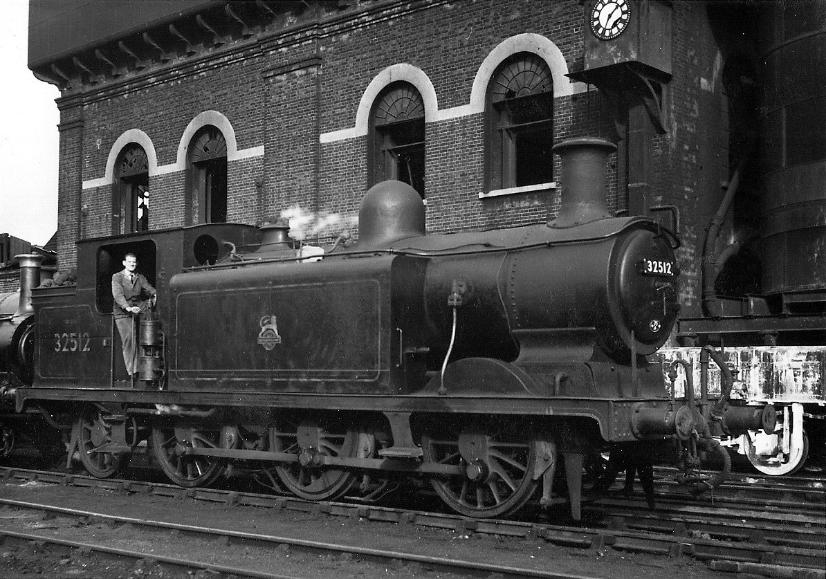
Brighton (former Newhaven) Driver Bill Terrill in Brighton Loco 1964
LOCOMOTIVE JOURNAL
FEBRUARY 1964
LEATHERHEAD BRANCH
We are pleased to report our branch has quite good meetings considering we are only a small branch. At our last meeting we had one of our original members retire, Bro. J. Chant, who had belonged to the branch since it was formed in 1947. A present a writing case from our members to our retiring Brother was made by the Secretary, with best wishes for good health and happiness for his good wife and himself in retirement.
Last but not least, I am pleased to report that all our members are clear on the last quarter’s return.
E.J. BeecherBranch Secretary
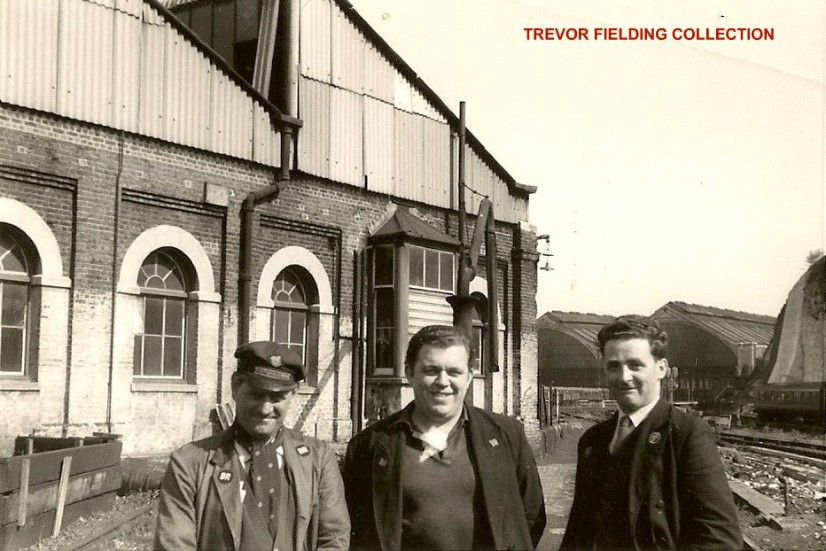
TREVOR FIELDING COLLECTION
BRIGHTON LOCO DRIVERS
Clifford Highams, Bert South & Trevor Fielding.
LOCOMOTIVE JOURNAL
FEBRUARY 1964
VIEW POINT
VINDICATION
On the morning of 8 February of last year a collision occurred between two electric passenger trains at Drayton, Southern Region. To quote the words of the Ministry of Transport Inspecting Officer’s report: “In dense fog the 7.50 a.m. Up Portsmouth Harbour to Brighton electric passenger train, which had been wrongly admitted into the section, collided at about 25 m.p.h. with the 7.37 a.m. Up Portsmouth Harbour to Bognor Regis electric passenger train, which was moving slowly after having been stopped at Drayton Up home signal. There were about 210 passengers in the two trains; 17 were injured, fortunately none very seriously,and the driver of the second train and the guard of the leading train were also hurt.”
The driver of the 7.50 a.m train - Bro. E.J. Chivers of our Bognor Regis Branch - said at the Ministry of Transport Inquiry into this accident that he saw the arm of Drayton Up distant signal rise to the clear position as he approached at moderate speed. He did not accelerate fully because of the fog so as to be sure of not missing the home signal, and the train as travelling at about 30 m.p.h. only when he suddenly saw the trailhead. He put the brake hands in the lap position and let go the deadman’s handle; he then opened the side door of the cab and got on to the footboard, whence he was thrown clear when the collision happened.
In his official report on the collision Col. W.P. Reed, the Inspecting Officer, laid the prime responsibility upon the another signalman; and criticised a guard for failure to carry out Rule 55 promptly.
Furthermore, he also was critical of Driver Chivers, for
“failure to make a full application of the Westinghouse brake in the emergency and his lack of appreciation of the delay element in the deadman’s control application.”
(In fact there is no delay on the stock in question, although there is of course, in the case of electric, diesel-electric or electric-diesel locos which have dual controls.)
This last criticism, based upon mistaken information, received publicity in the Press, along with the other comments referred to above. Accordingly, on the instructions of our Executive Committee, following their perusal of the documents, an approach was made to the Ministry with a view to a correction to the report being publicly made.
As a result we have been advised that the Press and other bodies to whom the original report was issued, have been sent copies of the following letter from the Inspecting Officer to the Minister:
“With reference to my Report dated June 19, 1963, on the collision between two electric passenger trains on February 8, 1963, at Drayton in the Southern Region, British Railways, there was an error in the information which I was given about the working of the compressed air brake when the deadman’s handle is released. I have since been informed that there is no designed delayed in the onset of the brake when this handle is released on the electric multiple-unit passenger stock of the Southern Region. The observations in paras. 11 and 20 of my Report would not have been made but for this error, and I accept that Driver Chivers’ action in releasing the deadman’s handle to apply the brake was fully effective.”
The high integrity of H.M. Inspecting Officers of Railways is undermined by this ready correction on the part of Col. Reed, to whom we tender thanks for thus publicly absolving Bro. Chivers from the measure of blame which had previously seemed to rest upon him.
SEE SUB PAGE
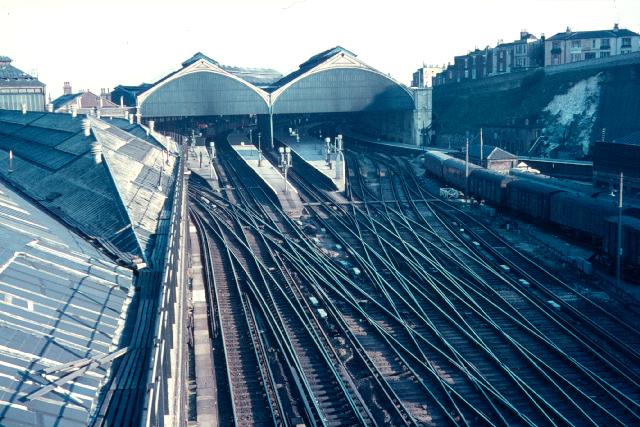
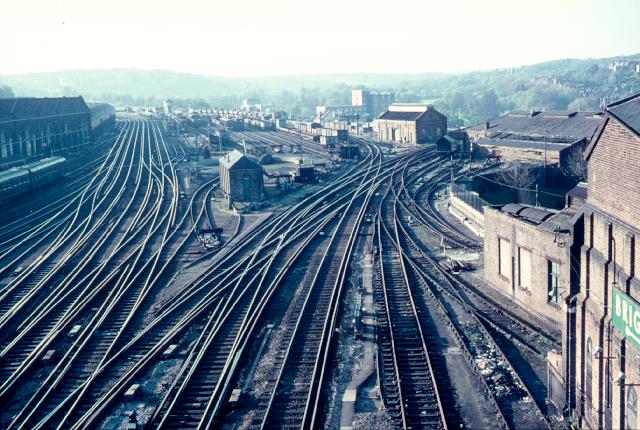
THE VIEWS FROM BRIGHTON SIGNAL BOX FOOTBRIDGE LOOKING TOWARDS THE STATION AND TOP YARD
LOCOMOTIVE JOURNAL
FEBRUARY 1964
PAGE 44
NORWOOD BRANCH
A.G.M. attendance fair. All branch officers filled for 1964. L.D.C. election controversy has now being resolved itself, and I trust all concerned will live together happily ever after.
Thos who have joined us here from the North are a grand set of trade unionists, and the combination of North and South augurs well for all in the future.
I regret to announce the passing away of Bro. Bert Goodhall after a long illness. A good trade unionist was Bert, and may he R.I.P.
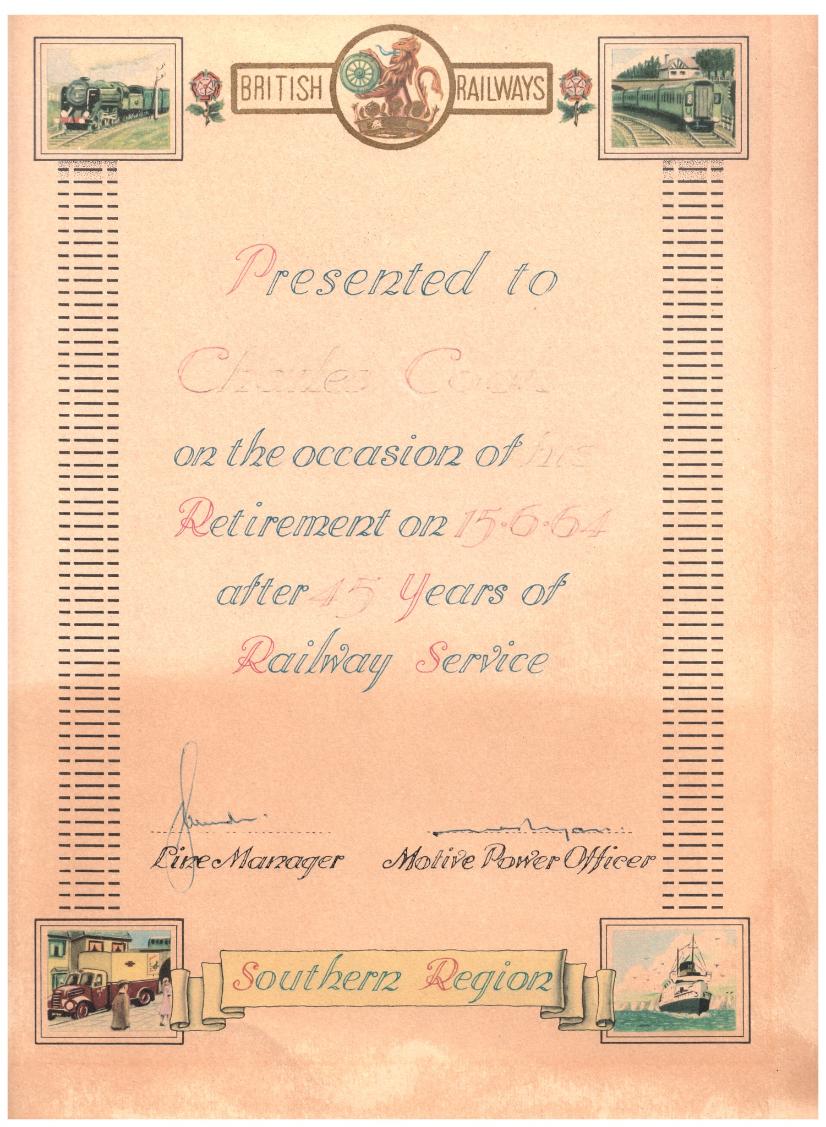
By the time this article appears I shall be no more on the “Front End,” owing to having retired at the age of 65. Also my A.S.L.E. & F. work will have been finished after 45 years. I have attended A.A.D. under five “Generals” commencing with the late Jack Bromley, and many friends I have made there from all parts of the British Isles, who will live long in my memory. To my own members here, again thank you for the very kind words and the splendid ovation given me at our A.G.M. I am sure all will give to my successor, Johnnie Hewing, the same fine assistance as you have given me.
In conclusion, I say to you all members, forward the A.S.L.E. & F.! It’s in you hands. Dum spiro, spero. “Au revior and Happy Hunting” is the wish I give to you all.
P.K. WILLSHAM
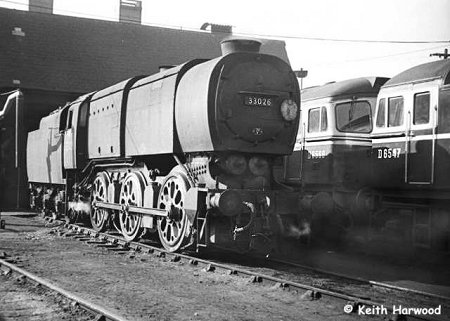
Three Bridges Loco Shed c1964
LOCOMOTIVE JOURNAL
MARCH 1964
VIEWPOINT
MORE B.R. FIGURES
On this page in January we commented on a provisional statement issued by the British Railways before the end of last year, estimating that for 1963 they would be able to show "a reversal of the adverse trend" towards larger financial deficits experienced over the previous seven years.
The British Railway Board has since publicised figures confirming the reversal, and showing a reduction of £17 million on the operating deficit for 1963, "an even larger reduction than was forecast," with a general decrease in costs and an increasing revenue from coal traffic. The Board states that although by September gross receipts for 1963 were £5 1/2 million behind those for the corresponding period of 1962, the difference was reduced by the end of the year to £1/2 million because of better results for the last four months.
Cleaner It would appear that the increased revenue from coal was almost exactly offset by a decline in other forms of freight traffic. Iron and steel traffics showed an encouraging improvement in the latter part of the year, "but other wagon load traffics are not likely to improve until some of the longer term changes which are being made have their effect."
There was only a slight improvement in passenger traffic receipts, in spite of an increase in fares. Increased receipts from season tickets were largely offset by a fall in ordinary fare receipts; a fall apparently due in considerable measure to a further drop in the peak holiday traffic. (It would seem that this last feature is welcomed by the Board, for its Press statement comments that this is "a form of change which can be more than matched by operating economies.")
The additional cost in 1963 of the 6 per cent pay increase of the previous November was £15 million; therefore, say the Board, the net saving of £17 million on the year represents n fact a total saving of £32 million. The main components of this total figure are said to be "roughly" as follows;
(a) £10 million reduction in costs of motive power (displacement of steam by diesel traction, more productive employment f locomotives);
(b) £12 million reduction in cost of all forms of maintenance; and
(c) £6 million reduction in cost of operation (in addition to the £10 million on motive power).
Regarding staffing, we are told that the reduction in total staff during 1963 was over 38,000, most of it achieved, it is stated, "by taking advantage of the normal wastage." Effect of this over a full year at present wage and salary level, a saving of about £28 million.
In announcing the deficit reduction the Board specially pointed out that that as yet many of the changes set forth in the Beeching Plan have not had time to have a real effect on financial results. Notwithstanding this we are inclined to agree with other commentators that the unusual early publication of figures is an attempt to provide a shot in the arm for tory ditherers about the Plan, whose ranks are swelling as the election comes nearer.
Moreover it is significant that, although by the end of January the Board had proposed 176 closure under the Plan, and T.U.C.C.'s had actual dealt with 68, the Ministry had only approved thirteen and declined one. This hold up has been neatly described by one observer as owing "as much to awareness of political consequences in a delicate pre-electoral situation as to any other factor."
In other words, the agitation against the Plan has been well worthwhile to date. Far from being relaxed, it should be steadily intensified between now and the General Election.
LOCOMOTIVE JOURNAL
MARCH 1964
LONDON BRIDGE
AT, our concluding meetings of 1963, suitable tributes were paid to the passing of Bros. Archie Patterson (late Scottish Organiser), Frank Saunders (Sectional Council Chairman), and Bro. Cooper of Victoria (E), who at an early age leaves a young family to be cared.
Changes are made in the Eastern L.D.C., with Ray Marchant replacing Jim Boyd who has stood down, and Ted Barnes nominated to fill my position. Having been officially nominated as candidate for the Sectional Council election, I am L.D.C, position, thus ending a 12 years association with the B. Arms Area Electrical L.D.C., 11 years of which I have been Secretary.
1963 found never a dull moment in our regular branch meetings, with a good liaison between branch decisions and L..D.C. campaigning.
Our Scots and Newcastle friends at Slade's Green are now settling down, and with the news of them all being housed, we extend the same convivial South Eastern welcome to their families in new surroundings. We wish to acknowledge the fraternal act of Jack Woolett of Slade's Green in immediately finding accommodation for the Newcastle lads on arrival, and to Don Greenway and his wife, Nessie, for their assistance and offers to accommodate the Scots lads.
"Brothers in Unity!"
H. Bagilbole, Branch Chairman
(We tender deepest sympathy to the relatives of the late Bro. Cooper.-Editor.)
Railway accident on British Railways
Southern Region
Central Division
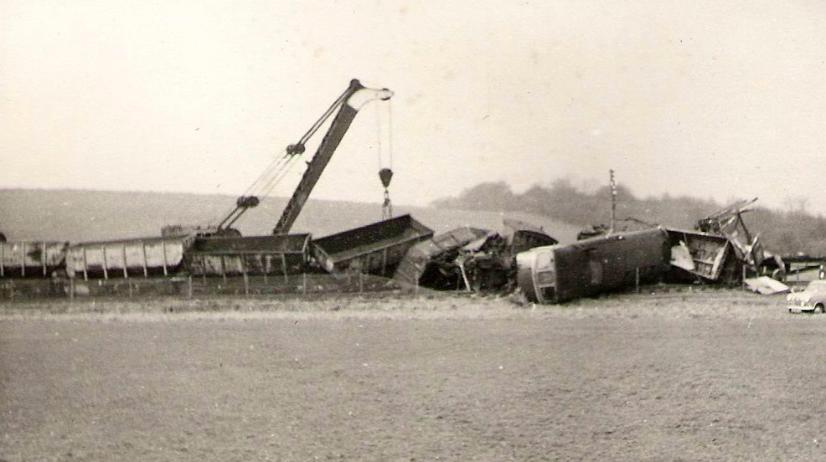
PHOTOGRAPHER UNKNOWN
BEN WILSON COLLECTION
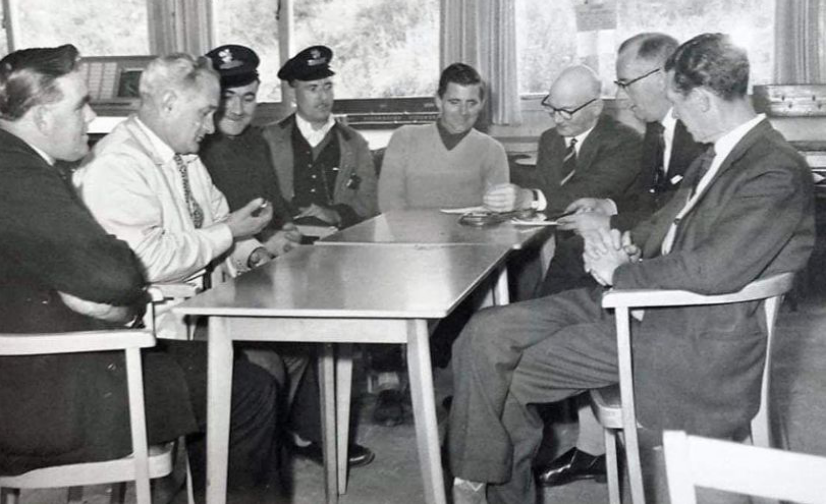
Three Bridges Railway Club Committee Meeting in the early 1960s
L-R Les Wilson, Peter Walls unknown guard, Doug Packham (guard), Roy Ansell,
Bob O'Donell, unknown 2 Charlie Stokes
LOCOMOTIVE JOURNAL
APRIL 1964
THREE BRIDGES
PAGE 86
The first meeting of the year was well attended. After a report on the subject of retirement presentation, it was suggested that those retiring be divided into two groups of four, the first social to be held in July. Individual collections will be made for each man.
Spare work from the E.M.U.T. depot is going to other E.M.U.T. depots; in a number of cases use of taxis is being made to carry men to and from other depots. An approach will be made will made to Management to see if greater use can be made of the relief link (M.T.).
The question of a continuing second manning was raised. It was pointed out that the matter was being discussed at Headquarters level.
The siting of Crawley Down Home was raised, also a warning light in a boiler-house, up side after Redhill. A final discussion dealt with whether the rates of pay Driver now receive are reasonable. With the different forms of traction a driver is expected to know, and the increase in single manning. It’s about time a move was made for substantial rise for responsibility.
The next Branch Meeting is 26 April.
Branch Chairman.
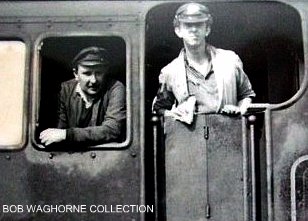
Driver Roy Tutt & Fireman Bob Waghorne in C1963.
Bob later transfered from Eastbourne to Tonbridge, Sevenoaks, Ore, St Leonards, and Hastings depots
LOCOMOTIVE JOURNAL
JUNE 1964
THREE BRIDGES
PAGE 126
Correspondence L.D.C. before the Branch in the main with second manning station limits, London to Brighton and Three Bridges depots; no one is yet support London Bridge. A second man now supplied at the other two depots.
On D.E.M.U. work for the depot, the management requires more economical diagrams. But it seem reason for no work is the fact the East Grinstead branch.
Retirement presentation raised again, and to prevent delay organisation it was suggested that as a pensioners’ social is being held in May the next presentation could be made then.
A point was raised in relation to a newspaper report on a serious accident in which two Brighton men were killed. In the report was a statement from a “Railway Spokesman” which contained a misstatement showing that the “Railway Spokesman” had very little knowledge of the locality. The “report” being sent to Head Office.
There is a Branch Meeting on 7 June.
Branch Chairman.
PHOTOGRAPHER UNKNOWN
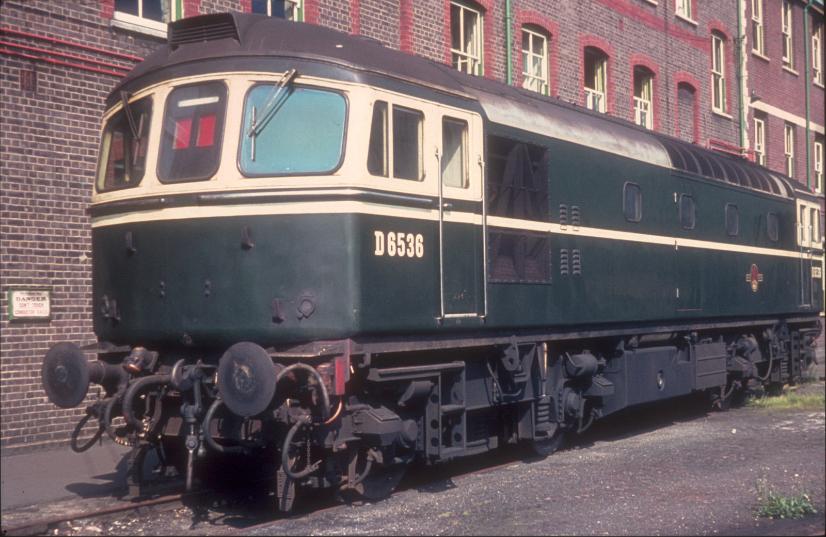
D6536 standing in Brighton Loco Works
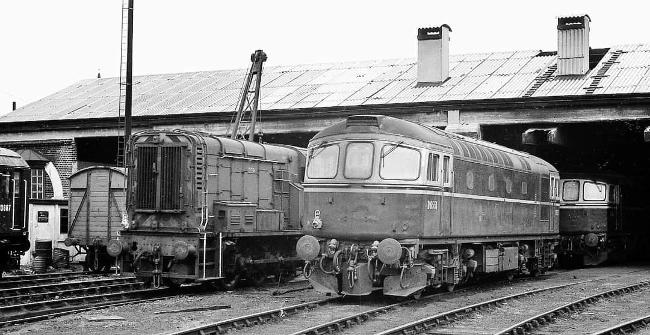
Diesels now standing in Brighton Steam Shed where steam locomotives stood a few months earlier
PAUL EDWARDS COLLECTION
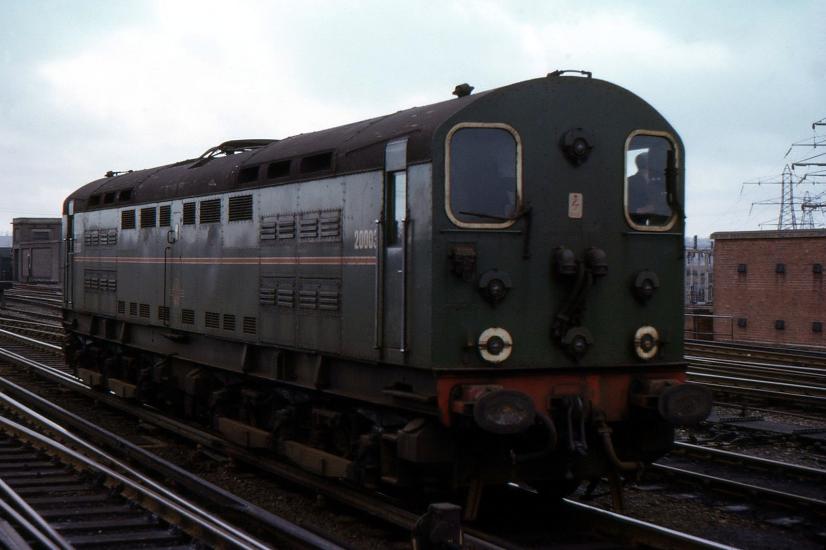
Memories of the Horsham Hornbys
By Rodney Burstow.
It was only Horsham and Newhaven men who originally worked these locomotives, at Horsham loco we had a “Hornby link”. Horsham men took them with open arms, and what a good job they did, I doubt Horsham Loco would have survived as long as we did if we hadn’t, our local goods and passenger traffic could have easily been covered by the likes of Guildford, Three Bridges and Brighton, as was proved in much later years!
Brighton, Three Bridges and the London men refused to have them for years. I can remember a certain driver who booked on at Horsham to work the Newhaven Boat and was told the Hornby was broken down and he was to be steam hauled he nearly S**t a brick, but he did it some how. I used to love these engines, powerful, but a bit too light on their feet, a fitted head was always useful. Second men used to go white some times, when running light engine.
I worked the Boat Train down to Newhaven, we had a couple of rostered turns if I remember. Once on arrival at Newhaven, the Guard came up really serious and informed me I was half a minute down at Keymer, but he would forget it as we were right time at the harbour!! We also work the Lewes goods, then light to Polegate and Eastbourne with the “Hornby's" Coal train from Polegate to Three Bridges. We also worked to Wimbledon Park and suburban area for special workings and maintenance, us “Hornby Gangers” got about a bit! When Horsham shut we took the work to Three Bridges.
Loco No 3, was fitted with the driver's seat you had to change ends with, they did give us one both ends in the ends.
Driver Reg Hampshire left with 10 hoppers steam hauled, I left thirty five minutes behind him and passed him between Salfords and Earlswood and I went via Redhill both going to Bricklayers Arms, Reg actually lost control down Forest Hill but thankfully was able to regain it.
Additional info provided by Biff Manvell
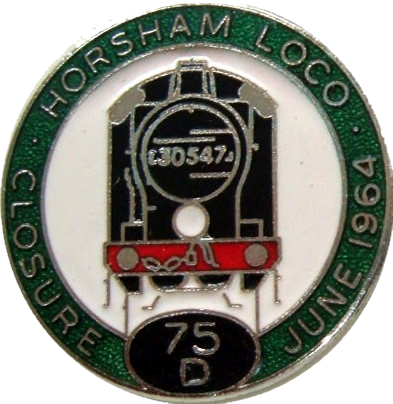
HORSHAM LOCO CLOSURE
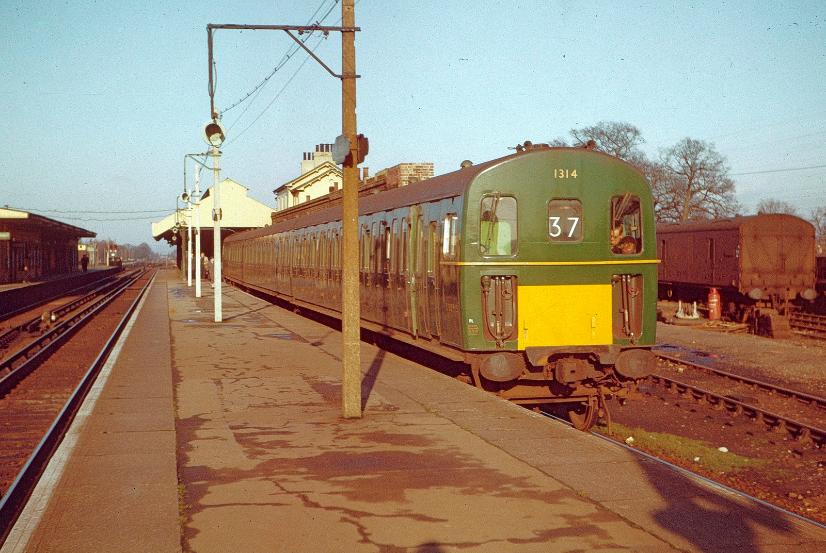
Horsham steam depot was closed on the 27th January 1964 and became a Mixed Traction depot, as a result of British Railways dieselisation program. On 14th June 1964 Horsham Mixed Traction closed and their work moved to Three Bridges steam depot.
LOCOMOTIVE JOURNAL
JULY 1964
THREE BRIDGES
PAGE 146
An open meeting was called on 26 April to hear an L.D.C. report on the closure of Horsham M.T. and the transfer of men and work to Three Bridges; also to hear and collect ideas on link structures and training required to make the new links workable.
The provisional figures for the depot will be 58 Drivers and 35 Firemen.
The depot will be allocated D.E.M.U. work on the Steyning and East Grinstead lines; but both these lines come into the closure plans.
When the L.D.C. met the Management they suggested a link structure which would have meant minimum displacement of men, also the minimum of extra training (E.M.U.T.). the Management would not agree, and now additional training will be requires creating disturbance of rosters.
There are a number of light duty men at Horsham and the Management suggested that they be accomoditated at Three Bridges. The meeting agreed that this could be done, providing they are placed at the bottom of the roster and are utilised as a last resort, not displacing any Firemen.
The L.D.C. must be complimented on giving a clear report.
Branch Chairman.
LOCOMOTIVE JOURNAL
AUGUST 1964
VIEWPOINT
B.R.B. JOINS IN
An interesting contribution o discussion of transport problems has been made by the British Railways Board in a document which they have issued entitled "A Study of the Relative True Cost of Rail and Road Transport over Trunk Routes."
Introducing this document, the Board pointed out that in their written evidence to the Geddes Committee on Carriers Licensing they expressed the view that "the efforts to achieve a sensible rationalisation of transport are unlikely to succeed unless the financial burden which each form to transport is require to bear includes a proper share of the true cost of providing and maintaining the facilities which it uses."
The board say they consider that at this time, when there is a good prospect of rationalised transport policy being evolved" (anticipation f Labour victory in the autumn?) it is of great importance that the relative "true" costs of the transport of freight by rail and road should be known, and that, for the purpose, the hitherto unresolved question of road system costs should be determined.
They go on to point out that past efforts to carry out such a road/rail comparison have been complicated by trying to compare the two forms of transport over the whole range. They explain that in this case, "recognising" that important competition between rail and road is "primarily" in the field of trunk haulage, they have confined their present study to the latter field. The result has been conveyed to the Geddes Committee.
In arriving at their conclusion the Board's experts have compared select examples of rail and road service for the conveyance of general merchandise; on the railway these examples comprise conventional and liner train services, and on roads, the operation of 10 ton and 16 ton articulated vehicles; with four track trunk routes by rail and two lane dual carriageway trunk roads and three lane dual motorways.
The results of the study indicate, in the Board's own words, "that the trunk road system costs are probably at least twice as great as the trunk rail system costs, and that the road freight transport operator probably pays no more than one third to one half of his road track costs." On the question of "conventional" rail services as compared with services by liner train, it appears that where the former are involved, the relative road-rail cost position is in favour of rad until the higher distances are reached, when it turns in favour of rail; on the other hand, we are told that where services are by liner train "the situation is in favour of rail for all but the shorter distances, with a substantial advantage accruing at the longer distances."
This exercise by the B.R.B. does not of course imply for a moment that Dr. Beeching is now marching shoulder to shoulder with Lord Stonham. what it does show, however, is that at least the Board at this stage has seen fit to encourage, with significant contribution, the discussion of transport issues on a broader basis; and this is all to the good.
B.R.B. REPORT
The annual report and accounts of the British Railways Board for the year 1963 has revealed a number of featured of outstanding interest. The report has shown that the Board's earlier forecast of a £17 million cut in their operating deficit over the year in question has been, in the words of the official press statement, "handsomely exceeded"; the working results were in fact £22 million better than in 1962. The public have been told that "this enables the Board to reaffirm in their report (the first since they were set up as an independent Board under the 1962 Transport Act) their view that the railways have now turned the financial corner" and that a continuing improvement in the financial position should follow.
Dealing with the manpower position the report indicates that total staff employed by the Board at the end of 1963 was 464,286, a net decrease of 38,417 (7.6 per cent), this reduction, it is stated, was largely achieved by natural wastage and by control of recruitment; the effect of such control being that recruitment during 1963 was 43 per cent below that of 1962, and almost 60 per cent less than in 1961 and 1960. This features was, we are told, "a big factor in minimising the redundancy problem involved in the reduction of the labour force during the year."
Passenger and freight receipts remained in total almost the same as in 1962; the improvement in working results was due almost entirely to reductions in costs. The main elements in these reductions are stated to be:
A reduction in train working costs (other than maintenance) due mainly to replacement of steam by diesel traction, but also reflecting better use of locomotives (improvement of £11 million).
A reduction in expenditure on the maintenance and servicing of vehicles (including savings due to replacement of steam by diesel traction) and on maintenance of track and signalling (improvement of £16 million).
A reduction in other costs, mainly of terminals (£7 million).
The Board's statement says that the above savings, which totalled £34 million, "were reduced by wages increases and minor changes in price levels."
With regard to the Beeching Plan, it is announced that only those changes proposed in the Reshaping Plan which were already in progress at the time the Plan was published in May, 1963 (in particular the reduction in the wagon fleet and conversion from steam to diesel traction), have so far had a significant effect on the working results. "The financial benefits of other changes made or proposed have still to come. Closures, for example, yielded little net benefit in 1963."
The report, which branches can obtain for 10s. (H.M. Stationery Office, per local newsagents) contains much that can be deemed constructive, strictly within the frame workimposezd by the directive, "profitability" at all costs, laid down by the present Tory Government, a Government which I hope we are all doing our bit to assist in sweeping from power in the near future.
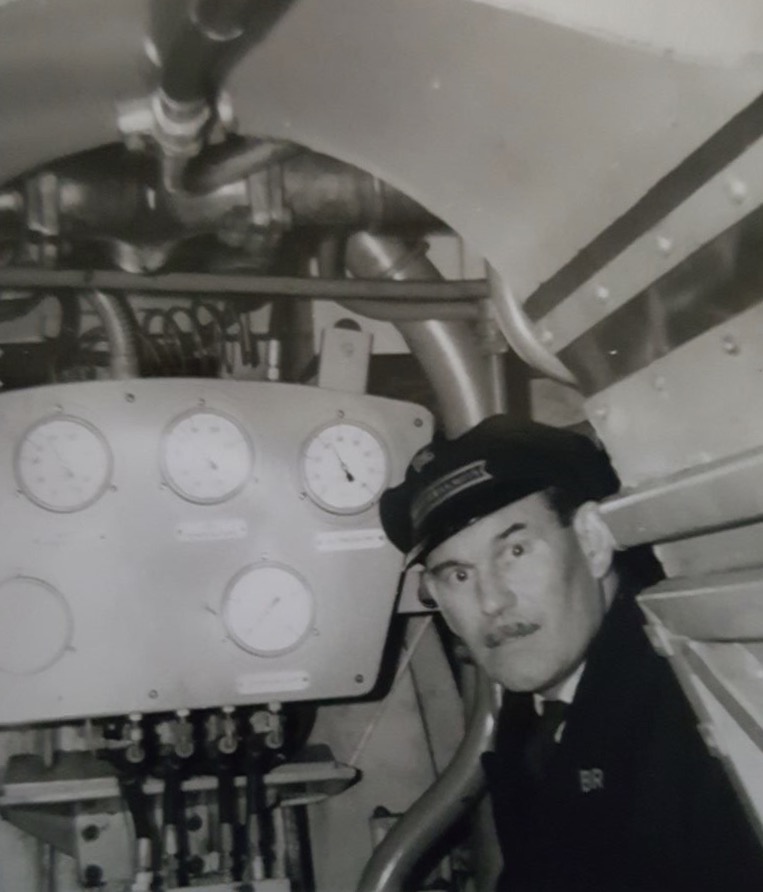
Bob Walls Collection
Tunbridge Wells Driver Vic Rumley
inside the engine room of BRCW TYPE 3 Locomotive
THE CLOSURE OF THE
MIDHURST TO PULBOROUGH
& PETERSFIELD RAILWAY
Freight Services ceased at Midhurst on Friday 12th October 1964, with freight workings between Horsham and Petworth until 1966.
However, there was the Midhurst Bell Rail Tour on Sunday 18th October 1964.
LOCOMOTIVE JOURNAL
NOVEMBER 1964
DISTRICT ORGANISER’S REPORT
PAGE 220
Sad new at Brighton where our good colleague Harry Neal received fatal injury in the
Collision at Lover’s Walk depot. Harry was a member of the Branch Committee and L.D.C.;
he was well liked by all who knew him, Members of Brighton (2) Branch and, indeed, all
members along the South East Coast, will miss him. At the recent M.O.T. Inquiry the Society was represented and the Ministry Report is awaited. Out Compensation Department is currently dealing with case and were rendering all assistance possible to our late member’s dependants, to whom we all express our sincere condolences.
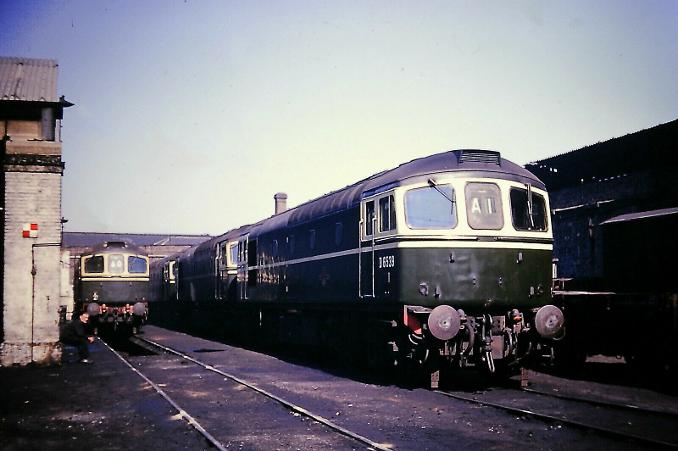
BRCW Type 3 (Class 33) Brighton Loco
LOCOMOTIVE JOURNAL
DECEMBER 1964
VIEWPOINT
A WELCOME CHANGE