Locomotive Journal
January 2004
Gatwick action suspended after new pay offer
The union is recommending suspension of industrial action on the Gatwick Express service following late night talks which resulted in a new deal .
“The settlement will mean that our drivers receive an 8.1 per cent pay rise for a 26 month
deal” said Steve Grant, ASLEF district secretary. “This is a win win deal our members were able to work this Christmas knowing that they are appropriately valued. I will be recommending to members that they accept this deal.”
The deal means that industrial action planned for 24 December did not proceed.
The pay deal takes drivers from £29,500 to £30,000 on the 31 April 2004 and up to £30,500
from 7 February 2005.
Gatwick employers that without a realistic offer action planned for Christmas Eve would go
ahead.
Steve Grant, ASLEF district secretary said earlier: “The employers fooled no one with their
talk of improved offers.
The reality of their 3-year deal was that it amounts to 1.5 per cent for each of the three years. This is just typical of the Gatwick management – they are out of touch with the reality of drivers’ pay.
“Drivers on the Gatwick line currently receive £28,215 per annum compared with drivers on
other South Eastern lines earning in excess of £30,000 already. If Gatwick want to retain
their staff and offer a competitive rate for the job then they must offer a £30,000 minimum."
Focus on Gatwick dispute
As you are aware we are in dispute with Gatwick Express over pay. Since last August the
company council at Gatwick, along with our lead officer Steve Grant, have worked tirelessly to achieve or members' aspirations in an amicable way.
On behalf of the members the company council went to Gatwick Express to discuss the pay claims at which time we were looking for an improved offer on a one year deal. The management informed us that to improve their original offer they would be looking for a two year deal. Subsequently, through negotiations we were able to reach an informal offer which we could take back to the membership and they could take back to NEG.
Unfortunately the board at NEG rejected the offer out of hand. Gatwick Express were then
informed that the membership would be balloted for industrial action over pay. An overwhelming result- 90 per cent in favour- was returned and Gatwick Express were formally given notice that industrial action would be taken in the form of one day strikes.
Then NEG two days before the first strike date proposed a deal of 12.5 per cent over three
years, but once again when looked at it was self financing at the expense of or Sunday
payment from time plus 25 per cent to flat time, plus trainee drivers’ pay when passed out'
year -25 per cent year 2-10 per cent plus reduction of one post plus postponement of the
settlement date by one month.
We have since had our first strike day and we hope that through negotiation we can still
meet our aspirations.
Mick Fursse
Gatwick Express
Company Council Secretary
Locomotive Journal
January 2004
Disgusted at remarks
I would like to offer Shaun Brady my congratulations on his election as general secretary. In
that respect I was astounded and disgusted to read Tony West's contribution in September's journal.
Bro West appears to be suffering from selective amnesia.
I sat in the executive committee room with Lew Adams and bro West on the afternoon that the 1998 GS election was declared.
Bro West, on receiving the news that Mick Rix had been elected
proclaimed that this was a ‘tragedy and the blackest day in the union's history.’ This however
is a minor point.
I take real issue with the view that the election of Shaun Brady is some sort of right wing
conspiracy.
No bro West, this is the grass roots members exercising their democratic rights. I offer a few possible reasons as why the rank and file members apparently do not share bro West's rose tinted view of Mick Rix’s tenure of office.
Could it have been the suspension of rule of three EC members who attempted to hold him to account? Could it have been the abortive libel action using union finances against a member?
Could it have been the autocratic and intimidating atmosphere that has prevailed over the last four years?
Could it have been the sycophantic adoration of a regime (Cuba) that still imprisons its political opponents?
Or could it have been Mick Rix’s Stalinist style of control over the journal and the issuing of union circulars that sometimes had a fragile connection with reality?
I could go on but I will end with this simple observation. Bro West uses the analogy of the world viewed from the bottom of a beer or wine) glass. In this respect, I must accept that Bro
West must remain unchallenged.
Bill Mackenzie
Former EC president
Brighton
Locomotive Journal
January 2004
Background to campaign
In the November (2002) issue of the Journal, the general secretary rightly complained that the Evening Standard denied those involved in the Tube dispute a right of reply. I am grateful that this statement has given me the opportunity to seek a similar response form ASLEF in their three-year campaign against Bill Mackenzie and myself.
Everyone should know by now that circular after circular, followed by the general secretary’s Journal comments, put his position in relation to the events that led Bill Mackenzie and I to complain to the Trade Union Certification Officer to what we had perceived as an abrogation of ASLEF rules.
After ASLEF circular 131/2001 and the April general secretary Journal article had named Bill
and I as assisting three former members outside the democratic processes, I wrote a Journal letter of rebuttal. It was never published and there followed three more attempts to try and have a ‘right of reply’, including a letter to Tony West in an effort to gain justice.
The general secretary’s only response was to indicate in the Journal that he wished to ‘draw a line’ under the proceedings. A very haughty view seeing that the only information the membership had was that that was determined by him.
In the February 2003 circular 056/2003 he again misrepresents, among others Bill and I, so I will again try to put the record straight.
Firstly, it must be understood that the events that took place within the EC in early 2000, and the subsequent High Court case had nothing to do with Bill and I.
What we complained about was the remedy taken by the then vice president Martin Samways. Any attempt to have our views dealt with were ignored and so we lodged four complaints to the CO.
Now let us look at the latest information (cir 056/2003). Space dictates that I generalise
thus:
Bill and I brought only four complaints (verified by CO ruling 1.7 who then states in 1.9 that
he, the CO, decided to hear all the complaints together). The CO ruled that ASLEF breached the rules in ‘suspending the EC’, ‘handing complete power and total control to the general
secretary’ and ‘reappointing an EC member who had resigned.’
He did not make an order. Circular 056/2003 implies that we sought to argue that the AGS
election should be statutory. Total rubbish. An election address was refused and we complained that legislation and ASLEF rule for the position of general secretary should apply to the position of AGS as he/she acts as GS in his/her absence. Thus an election address could not be ruled out.
The CO ruled against that complaint. Bill and I were satisfied with that result and left
the matter there.
The circular then presupposes that ‘six individuals mentioned above took part or supported an
application to the High Court’. A scandalous statement. Bill and I never supported any such action, and where is the evidence for such lies? It is also wrong to mention that that three errant members called for a special AAD. The truth is it was called by a 5 to 1 EC majority (see relevant EC res).
The circular then falsely states that ‘the six were not happy with the CO decisions and an appeal was lodged’. Bill and I were not party to that appeal before Mr Justice Lindsay. We had nothing to appeal against and it can be seen if one reads his findings in relation to complaints 1.7 and 6 that the CO found in the complainants’ favour and made declarations that supported the case that they had advanced.
The judge goes on to state that he could not rule on whether an order should have been made as that was a matter of fact and not law. One only has to see Mr Justice Lindsay’s transcript to see that it reads: ‘Mr Callagan and Mr Carrigan are appellants, ASLEF, Mr Glover, Mr Mackenzie, Mr Worboys and Mr Ballard are respondents.’
That is because those six did not appeal the CO decision. The circular also states that ASLEF
were not allowed to be represented but fails to mention that it was because they were out of time in presenting their skeleton argument.
The rest of the circular deals with the appeal in relation to Messrs Callagan and Carrigan
and that is the matter for the EC, when the full ruling becomes public.
I cannot comment on the case of the ET brought by Bill Mackenzie, only to say that there has been an application for a review and an appeal in law.
Bill and I have been maligned in our attempts to have the ASLEF rule book upheld. We don’t seek rehabilitation with those who have decided to malign us on the one-sided campaign they have read, but we believe that this business in relation to our involvement could have been put to rest three years ago if we had been allowed to contest the false information being circulated about us.
There will be those who will contend that we should have pursued our complaints through the internal process. I can only add that I have a record of every letter I have sent to the general
secretary and the Journal.
Perhaps one may consider why two retired members should involve themselves with this case. I have had friends ask me what we thought we could achieve. Let me say that this union belongs to the membership and its rules are upheld by the EC. Once lay EC (read membership) controlled is handed to anyone else outside of rule, then we are on a slippery
slope that has seen the decline of other once great unions.
Let me finish with the comments associated with the cost that all this has inflicted on the union. ASLEF employs an in-house solicitor. Bill and I have represented ourselves at every
stage. There is no cost to anyone who chooses to seek clarification at the certification
office. It was the general secretary who chose a Thompsons solicitor and a barrister, in preference to their own employee, to oppose us.
Len Worboys
Retired member

Locomotive Journal
March 2004
March 2004 marks the 20th anniversary of the start of the strike, which lasted a year and at its height saw more than half the country's 187,000 mineworkers on the picket lines.
written by Dave Dixon
Margaret Thatcher viewed the nationalised industries with utter contempt. Above and beyond the disdain for nationalisation, Thatcher was hostile to the unions and vitriolic to the miners in particular. We were still blamed for Heath's defeat in 1974.
As a member of the Heath government, Thatcher wanted to avoid such a defeat so it was
important to prepare for a dispute with the miners because at some point she believed that the NUM would need to be confronted and defeated if her privatisation plans were to succeed.
To do that she would need to entice us into retaliation and the only way to do it would be through a mass pit closure programme.
We have always accepted that collieries faced closure when the coal seams were exhausted or if geological conditions prevented economic mining.
Between 1926 and 1972 the NUM did not resist the pit closures. The mining workforce was reduced by more than 60% during the period 1956 and 1974, 75% of the collieries were closed and production plummeted by 50%.
Thatcher prepares
Following the 1979 election, the Thatcher government gave great emphasis to nuclear energy and pursued energy policies that moved away from coal. 11 per cent of household electricity bills subsidised nuclear energy.
The Coal Industry Act (1980) replaced production targets with financial targets. Financial targets were set so high that they could only be met by closing ‘uneconomic’ collieries. This
would force the confrontation.
Thatcher was to use the Ridley Report (1978) that included welfare benefits to be cut for
strikers and their families, coal stocks to be increased, power stations turned from coal firing to oil firing, increased coal imports, transport companies to employ non-union drivers and a special mobile squad of police to deal with social disorder from picketing and industrial violence.
The government began to pressure the coal board and in February 1981 the NCB produced
a list of 23 pits that had to close immediately. We prepared ourselves for action and called for
their withdrawal, Thatcher yielded to the demands because she was not ready to face the miners union head-on.
On 2 November 1982 Arthur Scargill released a statement, leaked by a secret mole in the
National Coal Board, stating that 75 pits were on a hit list. Scargill was ridiculed for this revelation.
September 1983 saw the appointment of Ian MacGregor, as the chairman of the NCB.
MacGregor was noted for his anti-union attitude established during his US career. Prior to joining the NCB, he had previously helped to decimate British Steel – a process that reduced the workforce by 100,000. The government’s preparation was now complete.
20 pits to close
In February 1984 we were like a coiled spring ready to be triggered.
We knew a strike was imminent and that trigger came with the announcement that 20 pits would close resulting in production cuts leading to 20,000 job losses. Among them was Cortonwood who previously received a £5 million investment with an expected five years of full production.
The Yorkshire miners’ response was almost immediate. We began arrangements to picket
mines outside Yorkshire in support of action against the closures. Within six days the whole of the nations coalfields were closed.
Of course we knew it would be a long strike but we were willing to suffer the two months we
thought it would take to convince the Coal Board that their arguments were unjust.
Contrary to popular belief the early months of picketing were peaceful, apart from the odd bit of verbal abuse.
As suddenly as the push started it would stop.
Pickets and police pulled out sandwiches and chocolate bars and swapped them while talking
about the latest football results.
These were replaced back into pockets and the push and shove resumed.
On one rare occasion at Ollerton Colliery I actually broke through a line of police. As I emerged on the other side I found that I was surrounded by a mass of boys in blue.
‘Bloody hell’, I thought, ‘and what do I do now?’
They totally ignored me, what an insult! I casually walked around the cordon of police and returned to the picket line.
On a sad note, during the night I was to witness the tragic death of David Jones, killed on picket duty outside the colliery.
Several months later the police strategy dramatically changed. No longer were we defending ourselves against the Coal Board’s pit closure programme but an unsympathetic state
machinery.
The police that we now faced were draftees from the Met, ruthless men equipped with batons,
helmets, kneepads and shields. In the late summer months we had retreated back to defend our own collieries and the mining communities.
During the strike 20,000 people were injured or hospitalised.
200 served time in prison or custody. Two were killed on picket lines, three died digging for coal during the winter.
966 men were originally sacked for no more than honouring picket lines, defending their jobs and pit communities, their class and the future of their children. Only a small number of
miners had been dismissed for offences against the person or damage to property.
Indeed, many miners since cleared by the courts were not re-instated and neither were many more who successfully won their cases for unfair dismissal at industrial tribunals.
Of those who were classified as sacked, few had their jobs back with British Coal. Many were even blacklisted from getting any work outside the coal industry.
Surviving on £15
Times were hard that year. We were clothed in handouts; food was short, and Christmas of 1984 passed us by, surviving on the £15 that the social security department grudgingly gave us.
That was £7.50 per child, nothing to the parents. And we were fortunate: the majority of miners received nothing.
At home potatoes became our staple diet, which tasted sweeter when they were pinched from the local farmer’s field. This was supplemented by the weekly food parcel and a hot meal provided by the hard working men and women who ran the soup kitchen. Providing fuel for the fire was the greatest challenge.
One winter’s day I forced my bicycle three miles through snow that was a foot deep in order to hack at the frozen cokeing coal that had spilled from the rail freight wagons down onto the rail embankment.
The bicycle was the only transport I owned, allowing me to carry one bag of coke. The cold was biting and I was feeling a little, well, let's say, not too pleased with the world.
As I arrived at my usual place of digging I saw at the other side of the tracks another striking colleague loading up a trailer whereas I only had a bike.
He was a lovely chap, but from that day on I hated that man with venom.
Pride and sorrow
What kept us going? Simply the support of trade unions, Labour Party branches and caring
individuals, but most important the realisation that
failure would mean an end to our mining
communities.
The staunchest supporter of the NUM was ASLEF. The rules were simple for ASLEF, if miners put even a token picket beside a line or bridge, drivers would stop. Ray Buckton said: ‘We knew pickets were on every coal depot. So therefore there was no movement there. Then of course it spread very quickly. Movements of coal in the network were stopped. It had to go into a place where they put pickets’.
Coal was being transported from overseas so it was agreed that a four man 24-hour picket was to be put on a bridge close to the Immingham docks, but this meant that the pickets had to stand overlooking the bridge so that the driver not only saw the banner informing that this was an official picket but he also had to see a picket.
After discussions with local ASLEF representatives it was agreed to purchase a mannequin, this became a fifth picket. Wagons of coal were sided and remained so until the end of the strike.
Twelve months on and my son was a year old. In the early hours of a March day I cradled him in my arms and with my daughter at my side we walked alongside people from the community, colleagues and friends of Hatfield Colliery NUM, COSA (colliery officials union) and a few supporting NACODs members.
Following the colliery band we marched back to the pit through the community we fought for, not with our heads held high but bowed low in sorrow.
Was it right?
The same questions are asked; was it the right time to strike, shouldn’t we have had a vote?
The answers are simple. Was the timing of the strike right, no. Did we really have any other
option, no.
As Arthur Scargill once said ‘One, you accept the plan and allow the pit to close. Alternatively; you fight it. If you fight and you have lost, at least you have fought it’.
As for the vote, we were not striking about pay or conditions; we were fighting for our jobs, our future, our communities. No person has a right to vote on these.
I remember clearly the pride, elation, bravery, fear, sadness and sorrow; every emotion that one would expect to experience in a lifetime, brought together during those 12-months and looking back I truly say, no regrets.
Locomotive Journal
April 2004
Gatwick Express warned
ASLEF’s executive committee has agreed to give the Gatwick Express managing director statutory notice of intention to ballot members on a series of discontinuous 24 hour stoppages if a range of issues are not resolved.
Concerns have been raised over a number of breaches of agreement by the company, including:
● monitoring of RDW by representatives
● not to pre-book cover turns
● new drivers to be trained on all traction on main line and diversionary routes
● budgeting for RDW without financial restrictions
● seven or more drivers during sanction of RDW to take annual leave days on same day
● refusal to allow representatives more involvement and input into staff handbook
Executive committee discussions centred on a reported deterioration of industrial relations between management and representatives over attaining release for secretarial days, no
access to office use or storage while requested adjustments to the rosters beneficial to both parties have still not being addressed and security checks not undertaken with unchecked
lost luggage left in booking on point.
Other issues included security doors unlocked and not working and a driver/deputy ops manager making divisive and inflammatory remarks about ASLEF representatives to other
drivers
Locomotive Journal
April 2004
Good memories
I have now left the railways after 43 years service, 37 of which I have spent as a driver at Epsom on the south central division. I have been ill for almost a year with a recurrence of a previous illness and so at 60 I’ve ‘reached the buffers’, as they say.
The past year has been very traumatic for my wife and I as anyone who has been on long-
term sickness can testify. I could not have dealt with the stress involved without the help and
support of Roy Luxford, and the company council and Graham Morris, district secretary.
Their knowledge and advice was insurmountable.
I would especially like to thank Roy for his constant support throughout my ordeal, his
regular visits to my home and his many phone calls and emails. You certainly see the
importance of being a member of our specialist trade union when you need help.
Best wishes to all my colleagues at Epsom EMUT and to all the friends I’ve made over the years on south central.
There has always been a great feeling of togetherness among the footplatemen on the
Southern – long may it flourish.
I have enclosed a donation of £100 for the hardship fund.
Ron Thomas
Epsom Downs Surrey
Locomotive Journal
April 2004
BERNARD NOAKES
It is with regret I report the passing away of retired driver Bernard Noakes. He was 79.
He transferred from Tattenham Corner to West Worthing and was on sectional council duties
while there. Bernie was a cheerful, busy person and held his union duties very close to his heart.
He lived for many years at the station house at Goring, just a short step to the depot at West
Worthing where he retired after 48 years' service. He will be sadly missed by his colleagues
and we send our condolences to his wife Eileen and family.
The funeral service was well attended with a good number of retired drivers .
Ian Munro
retired drivers section,
Worthing
Locomotive Journal
May 2004
The Ball is in AAD’s Court
For the last six months we have been through a period that unless resolved at this year's
conference will see this union fragment to a degree that will take years to overcome, if ever.
The Kelly report may have been finalised by the time this letter is published, but my
contribution is based on the events that were relevant on 28 April.
The general secretary had a horrendous task when he came to office and it will take some
forgiveness for people like me to come to terms with the way the previous general secretary
left him without a proper transitional arrangement (GS flat signed over to the caretaker) and a non existent financial department.
After taking up his appointment and finding that he had no financial department and many financial files and their back up tapes missing, the GS commissioned a report relating to our financial status, to be produced in four stages to the EC.
On January 3 the EC passed a resolution that noted the first interim report and set out stages when the further four reports should be presented to them, ending with ‘A full review of ASLEF finances to be conducted and reported to this EC in the March 2004 session.’
At this stage it should be noted that at no time did the EC recommend where the GS was to obtain the expertise he needed, nor did they object to the fact that the stage that they had just noted had been produced by P Blagbrough.
The resolution concluded: ‘Furthermore. this review to be with the general secretary,
ASLEF trustees, ASLEF auditors, representatives of the ASLEF financial department and the
EC.’
When the meeting took place, where it was expected to debate the draft copy of the
Blagbrough report, the auditors, trustees and, to my knowledge, ASLEF financial department
were not in attendance.
The report was rejected, a new EC resolution, 319/424, was produced and adopted by a 5:3 majority.
The excuse the EC used in rejecting P Blagbrough’s report is contained in the first para of
319/424. It quotes: ‘That the report be rejected, due to the inaccuracies and discrepancies
contained within the draft report, and P Blagbrough's letter dated 21 March.’ This makes a nonsense of the PB letter. His letter is one of complaint about the leak to the Mail on Sunday.
It states: ‘Last Wednesday I provided 5 copies of my draft report to you. The purpose of
doing so was to allow you to have an early sight of the facts established by me in order to
ensure that any inaccuracies in the report might be identified and corrected before the report
was given wider circulation to the executive committee…’ The letter goes on to complain on
how the report was released to the press and a breach of good faith.
319/424 also fails to inform us of the ‘inaccuracies’ that the EC felt that they could not accept within the report.
Further, there are no EC minutes that can confirm who authorised the appointment of M Kelly to conduct the investigation prior to his appointment appearing in the resolution. No debate about terms of reference, cost or whether other QCs had been considered. Nothing?
Another important aspect of the events leading up to the adoption of 319/424 is the failure of the EC to give the membership a reason as to why the EC president ignored three attempts made by P Blagbrough to meet with him and the EC to go over the draft report.
319/424 is flawed because it breaches ASLEF rules: 1 (d), 6.2 (I), 6.2 (xv), 7.1 (b) and
7.1 (c). it also disregards the EC's own resolution of 3 January 2004.
Although the Blagbrough report has been rejected it makes serious assertions about our investment management, loss of computer files, financial performance and other insights
into what is alleged derogation of financial duties.
The Kelly report will have to investigate those areas covered by Blagbrough and if they are
not as indicated, Kelly will have to tell us where they are wrong.
Finally, we come to the crunch issue. This year’s conference has to ask itself who makes the
rules of ASLEF. The answer should be obvious, it is those who have been elected to do
just that at the AAD, the delegates.
In 2000 breaches of rule were also made (confirmed by a Certification Office ruling). No
order was made because the CO ruled that a special conference had endorsed the actions of the perpetrators of the rules.
Conference now has a task of deciding the relevance of themselves. If the EC can be allowed to breach rules with the hope that a future AAD will endorse what they have done, there is no need for rules. What we would be left with is an EC making decisions that would then require the endorsement of those decisions, or not, at a future conference.
So AAD delegates, are you relevant, are the rules you pass relevant, are you the parliament
of ASLEF? The ball is in your court.
Len Worboys
Retired member
Locomotive Journal
May 2004
BRIGHTON
PETER KIMBLE
Peter passed away over Easter Sunday after being off sick and been told that he had stomach
cancer.
Peter was a well liked member of the train crew department at Brighton, having joined the
railway in 1974. He became a secondman and then was passed out as a driver for EMU Trains.
He was a very private person, tending to make friends away from the railway, but still would
want to be looked upon as part of the depot.
Peter died at the young age of 46 and had only been off work for nine weeks. He remained a
single man, choosing to live and care for his mother. Peter also leaves a brother and sister for
whom he cared greatly.
He passed away with his family at his bedside.
Chris Newton
staff side secretary
Brighton depot
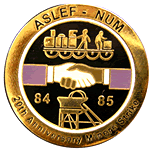
20th anniversary of the 1984~5 miners strike badge
On 30 March 1984 ASLEF asked its members not to transport coal, followed by the NUR on
3 April. ASLEF members stood shoulder to shoulder with the pickets and placed their own jobs at risk by refusing to move coal wagons, some of those wagons were sided until the
end of the strike.
As the solidarity shown by the NUR and ASLEF members began to take effect many drivers and guards were threatened or victimised by management, particularly those engaged in the Nottingham area. Some were sent home when they refused to work normally and this eventually led to a regional strike on 17 January disrupting trains from parts of London, Yorkshire and the East Midlands.
At national level, ASLEF became one of the staunchest supporters of the strike assisting the struggle with funding and the collection of food parcels. At senior level general secretary, Ray Buckton, became central in the discussion among supporting union leaders about tactics
during the miners’ strike.
In commemoration to the solidarity of ASLEF during the miners strike and its historical links to the mining communities the executive committee agreed to the production of a limited 20th anniversary miner’s strike badge. The price of the badges will be £3 plus postage and packaging. Proceeds of the sale will be donated to the Justice for Mineworkers and another selected charity.
A date will be arranged for the launch of the badge and it is our privilege that Arthur Scargill, president of the NUM during the strike, has agreed to be ASLEF’s honoured guest at the event.

Railway accidents on
Southern
Locomotive Journal
June 2004
DONALD K. PULLEN
FORMER A.G.S.
It is our sad duty to inform members of the death of former assistant general secretary Don
Pullen. The funeral was on Thursday 27 May at Charing Crematorium, Kent.
It is sad to hear of the death of former assistant general secretary Don Pullen.
There was a saying that related to Don, that ‘he was the best general secretary we never had.’ That came about because he was older than Ray Buckton and would never become GS
whilst Ray stayed healthy, for in those days the job of GS was for life.
Don was one of a remarkable team of officers. Not only were we blessed with Don and Ray,
we had George Thomas and Johnnie Walker, not to mention those very able colleagues who came after Don retired.
In Don’s day, until 1974, the AGS had the responsibility of dealing with all compensation
claims and he was also the chief negotiator for the then London Underground. I am sure there will be many old hands from LUL who will wipe a tear at his demise.
On a personal note Don and I had some great times when Pauline and he joined us at Fratton on our annual trips abroad. We used to virtually hire a plane, out of season, to take us to Spain. Sadly dear old Billy Williams, who also came, is no longer with us, but I’m sure Les
Johnson will recall those days with nostalgia.
So my friend Don, you got to meet some remarkable people. They will have your place at the
table waiting for you. Not many chairs are left now, but yours is reserved with pride.
Our thoughts are with Don's family. I hope their grief will be somewhat easier to know the
affection and respect we all had for Don.
Len Worboys
retired member
Locomotive Journal
July 2004
DONALD K. PULLEN
FORMER A.G.S.
It is with sadness that I report the passing of Don Pullen (DKP as he was often known), a great friend to all. Once you met Don you made a friend and it would not be long before you became aware of his family with Pauline.
Don had followed his father into the footplate line of promotion at Ashford in Kent and joined the Society during his first week.
He worked his way through the links until he gained promotion to motorman in London. He was soon to take on the staff side local departmental committee.
He became well known at other depots and London branches – his negotiating skills were well recognised – and was always on hand to give advice to new branch officers.
Don was to become a great advocate for the Associated Society of Locomotive Engineers
and Firemen – that’s how we best remember it before ASLEF was invented by the media. He
starting in the branch room and getting involved, he would fight long and strong to defend its
name and members.
Active during the 1955 Society strike, he joined pickets and attended meetings with members, encouraging them until the executive did a deal good enough to return to work.
He became a member of the executive committee on 2 January 1956 – the same day
as Ray Buckton.
He was elected as Society organiser in December 1962 and then became Irish officer in
January 1963.
Don rose to be assistant general secretary in 1971, expanding his talents to cover national negotiations under the direction of the general secretary and to represent our LT members on wages and conditions of service.
Most people that knew Don would have an experience to relate of how he came along and sorted out a problem, how he helped them with their work, with his amazing knowledge of
agreements and the work of locomotive men. He would run schools on numerous subjects, a favourite of mine was on accident prevention.
Within the Society Don was always a leader in our campaigning work and he marched us to the Chilean Embassy in London with the Society banner after President Allende’s government was overthrown.
I stood with Don many times outside the American Embassy, protesting against the Vietnam
War. Don also arranged a school in France to join with our CGT colleagues to debate the
prospects for us if we joined the EU. A few years later after we joined we travelled to Brussels and led the railway transport workers’ demonstration at the European Parliament.
He wrote regular book reviews and many articles in the Locomotive Journal. Where did he find the time and energy to write so much?
I mention his great love for cricket. He took me once to the house where, as a little boy, he
would cross the road onto the village green at Faversham and play cricket – the tree was the
stumps and the tree was still there.
His ambition was to play for Kent, but the greatest reward was when he became a member of the MCC. His other sport was golf and he would often play with railway colleagues at the club they formed.
Don’s great family of friends took in all those that he negotiated within management, the huge number of people of other trades unions and all others that he associated with.
His ambition to become general secretary never came his way.
Don, you played a tremendous innings. The appreciation for Don was shown by the numbers that attended his funeral.
To Shirley and family condolences, your father was a great man.
George Saville
retired member
Shoeburyness
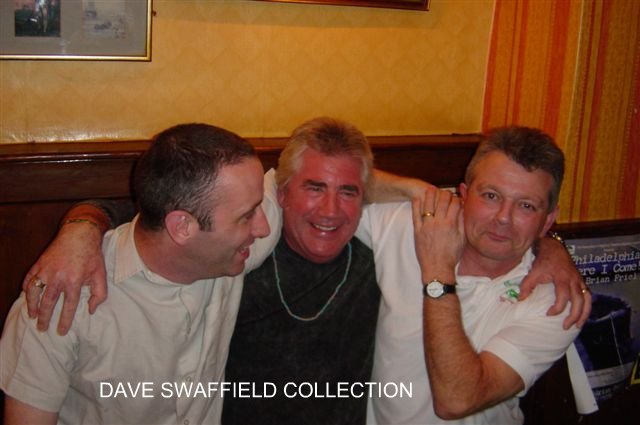
Brighton Thameslink retirement and leaving due 2004
Left - Right: Steve Doyle (moving to St. Pancras), Ken Winter (retiring)
& Phil Stoddart (moving to Penzance).
Locomotive Journal
August 2004
Rail unions demand public ownership at Commons rally
Simon Weller eyewitness at the lobby
The press conference launching the lobby began with ASLEF district secretary Steve Grant fielding questions followed by a massing of the banners for a BBC photo-call in the shadow of parliament.
Those who had used www.faxyourmp.com were pleased that MPs were aware their constituents wished to see them. Whether they deigned to meet us was another matter …
Why the need to lobby our MPs? It is apparent that the early promise and ambition of New Labour’s 10 year plan for rail is being lost.
Rail unions have been at the forefront of campaigning for a return to a fully accountable and
integrated public railway and rank and file ASLEF members were much in evidence.
Within the grand surroundings of the Palace of Westminster district secretary Graham Morris
addressed a packed, full and standing Committee Room Ten.
He stated that ownership was absolutely pivotal in control of an undertaking and called for
the government to take the opportunity presented by South Eastern and keep it within the
public sector and not farm it out as yet another cash crop for private shareholders.
Graham raised the real need to address the Freight Facility Grant and the whole concept of
freight on rail. This would not only protect ASLEF members but also free our roads from the
unnecessary environmental; economic and social problems caused by congestion.
Gwyneth Dunwoody praised the ASLEF supported Catalyst paper ‘Renaissance Delayed?’.
In the years preceding privatisation the publicly accountable British Rail gave the best value for taxpayers money per pound per passenger kilometre in comparison with the European average. In the period 1986 – 1994 BR received between 0.1% and 0.2% support from public funds whereas the European average was 0.6%. Compared with productivity per train kilometre BR easily out performed its European neighbours.
Imagine what could have been achieved if the levels of public subsidy hadn’t been the average, in today’s money, of £1 billion but the £3.5 billion of recent times.
She concluded that the most effective model for today’s railway is one that is publicly owned and accountable.
That was also the conclusion of Bob Crow of the RMT. He spoke of his surprise when
Labour MPs express their concerns of the amount of compensation potentially payable to private shareholders in the event of renationalisation.
What amazed him was the MPs didn’t realise it was, quite simply, none. The current
arrangements with the extension of certain franchises allow for five year breaks. These breaks allow for the government to take back the keys without the need for compensation.
The campaign is about getting the facts to MPs and getting them to take back the trains from the privateers.
This highlights the effective campaigning work ASLEF does which would be lost without a political fund. The battle to bring the control of Britain’s railways back into the public domain is not over yet.
Simon Weller
is from ASLEF’s Brighton Branch
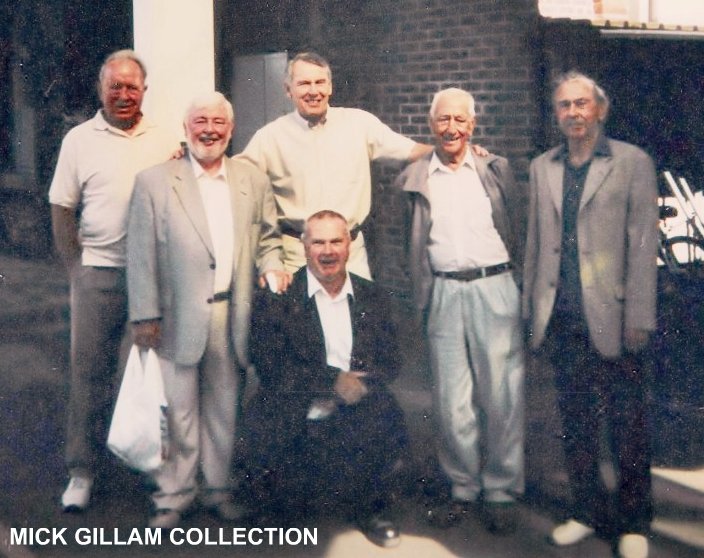
Littlehampton Drivers
Left to Right standing Mick Knott, Terry "Barney Rubble" Edwards, Mick Gillam, Alec Lovell, John Sanders and Knelling is Jim Blyth.
The photo was taken at Littlehampton station en-route the way to the Nine Elms Reunion c2004.
(Littlehampton & Barnham depot)
Railway accidents on
Locomotive Journal
October 2004
The Way Forward For A.S.L.E.F.
Kelly states that problems occur due to arguments over primacy of the EC and the GS. He
highlights problems in union administration. That is why this union has to make structural changes. We have to take a radical close look at ourselves.
We have our third general secretary since Ray Buckton (fourth with the acting GS). Each
time there is scandal, court cases and disrepute charges.
Money is wasted on inquiries when we all believe it could be spent better.
We have an opportunity now to make fundamental changes. We should reconsider the role
and position of the general secretary. The recurring problem is the legitimacy of the nationally elected general secretary and the regionally elected executive.
The rulebook states the GS is under the instruction of the EC, and Kelly supports this. This
power struggle will surface again.
The GS role can be incorporated into the position of president as chair of the executive committee. This position can fulfil the figurehead role on the political stage and in
negotiation with employers as the members’ representative – nationally elected from senior members of the executive – a person with experience and respect within the union and an
EC member for at least one term.
The president’s position would be full time as the GS is now but with a term or EC members
extended from three years as at present to five years. (Ordinary EC members to stay on a three year term. This will allow the new figurehead to outstay deselected EC members and allow reselected EC members to challenge for the position.)
The role of the president will purely to be as figurehead in negotiations with employers and
in politics and the trade union movement as a whole whilst following the instructions of AAD
policy and the executive. The role would be to further the interests of the membership and
to lead the union on their behalf.
That leaves what to do with the day-to-day running of the union. ASLEF has financial assets, is an employer of staff; provides membership services and procures services from outside
organisations. It has statutory requirements to operate as a trade union with accounts, banking, ballots for positions, branch funds, appeals, running head office and much more.
This organisation cannot be run like the local BRSA Club. It’s assets are too big and the
requirements on it too vast. It is too big a job to expect someone from the driving grade to run it. They do not have the necessary skills. It is time to employ someone from the outside.
Such a ‘chief executive’ could have experience of a Not For Profit organisation, be an
employee who reports, follows instructions and answers to the E.C. They would be an employee of the members with responsibility for running ASLEF on a sound financial basis.
The next Rulebook change AAD is 2006 after this year.
The EC should carry out a feasibility study and to report to the 2005 AAD on their findings.
This will enable branches to have their say in open discussion and with branch resolutions.
When the 2006 AAD Agenda of Suggestions is published in late 2005 we can see how the
EC are going make the structural changes necessary to the rulebook and have opportunity to
propose amendments.
Once the 2006 AAD approves these changes, it will enable the EC to recruit for the positions by 2008, the end of the current GS term, or if the acting GS is still in position these changes could be implemented by 2007.
These proposals are in their infancy. Discuss them at branch meetings and in the mess room.
If you agree with the basics send in branch resolutions in support of these proposals to the EC.
Matt Stanley
Horsham

Railway accidents on
Southern